
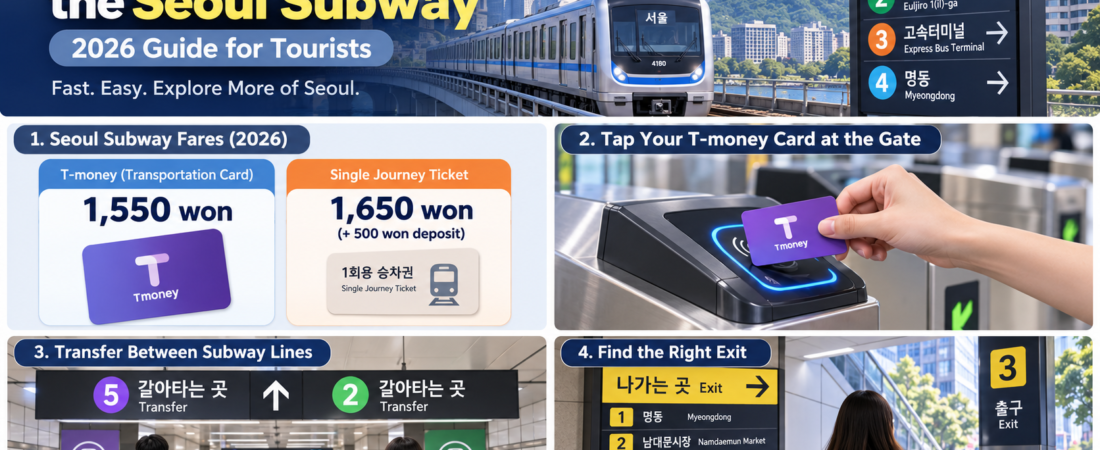
Using the Seoul subway can look complicated at first, but it is one of the easiest and most efficient ways to travel around the city.
Stations have English signs, subway lines are color-coded, and transportation cards such as T-money make paying for rides simple.
This guide explains how to use the Seoul subway step by step, including fares, tickets, transfers, exits, and common mistakes to avoid.
How the Seoul Subway Works
The Seoul metropolitan subway network connects most major tourist areas, including Myeongdong, Hongdae, Gangnam, Dongdaemun, Seoul Station, and many destinations outside central Seoul.
Each subway line has a number, name, and color. When planning a trip, focus on three things: your starting station, destination station, and any transfer stations along the way.
How Much Does the Seoul Subway Cost?
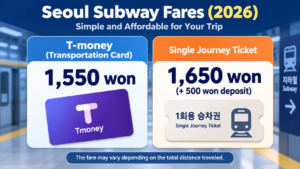
For adults, the basic subway fare using a transportation card is 1,550 won.
A single journey ticket costs 1,650 won for the same basic fare. Additional charges may apply depending on the total distance traveled.
Subway fares can change, so check the latest official fare information if your trip is far in the future.
Should Tourists Use T-money or a Single Journey Ticket?
For most tourists who plan to use public transportation more than once, a T-money card is usually the more convenient option.
You can tap the card at subway gates and use the same card on many buses and other participating transportation services.
If you do not have a transportation card, you can buy a single journey ticket at a subway station ticket machine.
Single Journey Ticket Deposit
When purchasing a single journey ticket, you pay the fare plus a 500 won deposit.
After arriving at your destination and leaving through the gate, insert the used ticket into a deposit refund machine to receive the 500 won deposit back.
Step 1: Find Your Subway Route
Before entering the subway, check which line you need and whether you need to transfer.
Major subway stations display station names and line information in English as well as Korean.
You can also use map and navigation apps to check the fastest route, number of stops, transfers, and estimated travel time.
Step 2: Enter the Correct Subway Gate
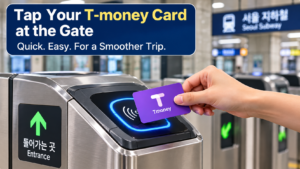
Once you reach the station, follow signs for the correct subway line.
Some stations serve several lines, so check the line number and color carefully before entering.
Tap your T-money card on the card reader at the turnstile. If you are using a single journey ticket, place the ticket on the reader as instructed.
Step 3: Check the Direction Before Boarding
This is one of the most important steps for first-time visitors.
Platforms may serve trains traveling in opposite directions. Look at the station names shown on signs and check the next major station in the direction you want to travel.
Do not rely only on the platform number because station layouts can vary.
Step 4: Transfer Between Subway Lines
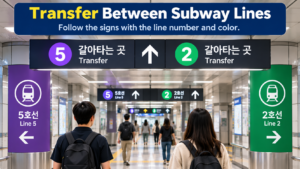
If your route requires a transfer, follow the signs marked with the line number and color of your next subway line.
Transfers between most subway lines are completed inside the station without exiting through the main turnstiles.
Walking distances between lines can be long at large transfer stations, so allow extra time if you are carrying luggage.
Do You Pay Again When Transferring?
Normally, you do not pay another full base fare simply for transferring between subway lines inside the station.
Your total fare is calculated according to the integrated transportation fare system and the total distance traveled.
Some special lines may have additional charges.
Step 5: Get Off at the Correct Station
Subway trains announce upcoming stations and transfer information, and displays inside the train show station names.
Start preparing to get off when your station is announced.
At busy stations, move toward the door before the train reaches your stop so you can exit comfortably.
Step 6: Choose the Correct Exit
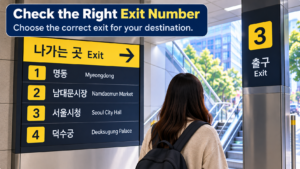
Large Seoul subway stations can have many exits.
Choosing the wrong exit may leave you several blocks away from your actual destination.
Before leaving the station, check your destination on a map and identify the correct exit number.
Exit numbers are clearly marked inside most stations.
How to Use T-money When Leaving the Subway
When you reach your destination, tap your T-money card again at the exit gate.
This allows the system to calculate the correct fare based on the distance traveled.
If your card does not have enough balance, look for a fare adjustment or recharge machine near the gates.
How Subway and Bus Transfers Work
Transportation cards can provide integrated transfer benefits between eligible buses and subways.
To receive the correct transfer fare, always tap your transportation card when entering and leaving the subway and when boarding and getting off buses.
According to Seoul’s integrated public transportation system, transfers generally need to be made within 30 minutes after getting off the previous mode of transportation, with a longer transfer window during late-night and early-morning hours.
Can Tourists Use English at Seoul Subway Stations?
Yes. Major subway signs include English, and many ticket machines offer foreign-language settings.
Station announcements and onboard displays also commonly provide English information for major station names and transfers.
What If You Take the Subway in the Wrong Direction?
If you realize you are traveling in the wrong direction, get off at the next convenient station and follow signs for the opposite platform.
Depending on the station layout, you may be able to change direction without leaving the paid area.
At some stations, the opposite platform may require a different route through the station, so follow the signs carefully.
What If Your T-money Card Does Not Work?
First, check whether the card has enough balance.
If the gate does not open, do not repeatedly force your way through the turnstile. Look for a station staff member or use a fare adjustment machine if available.
If you need more information about buying or recharging the card, see our guide to buying a T-money card in Korea.
Common Seoul Subway Mistakes to Avoid
- Entering the correct line but taking the train in the wrong direction.
- Ignoring exit numbers and leaving through the wrong side of a large station.
- Not keeping enough balance on a transportation card.
- Forgetting that large transfer stations can require several minutes of walking.
- Waiting until the last moment to move toward the train door at a busy station.
Useful Tips for First-Time Visitors
- Check the line number and color before entering.
- Confirm the train direction before boarding.
- Use T-money if you plan to ride public transportation regularly.
- Check the exit number before leaving the station.
- Allow extra time for transfers at large stations.
- Check the last train time if traveling late at night.
Frequently Asked Questions
Can tourists use T-money on the Seoul subway?
Yes. T-money is widely used for subway travel and other public transportation in Seoul.
How much is the Seoul subway for an adult?
The adult basic fare is 1,550 won when using a transportation card and 1,650 won for a single journey ticket, before any additional distance-based fare.
Can I buy a subway ticket without T-money?
Yes. Single journey tickets are available from ticket machines at subway stations.
Do Seoul subway ticket machines have English?
Many subway ticket machines provide foreign-language options, making them easier for international visitors to use.
Do I need to tap my T-money card when exiting?
Yes. Tap your card when entering and leaving the subway so the correct fare can be calculated.
Final Thoughts
The Seoul subway becomes much easier once you understand the basic routine: find your route, check the line and direction, tap your card, transfer inside the station, and choose the correct exit.
For most visitors, using a T-money card and checking the route before entering the station makes traveling around Seoul fast and straightforward.