
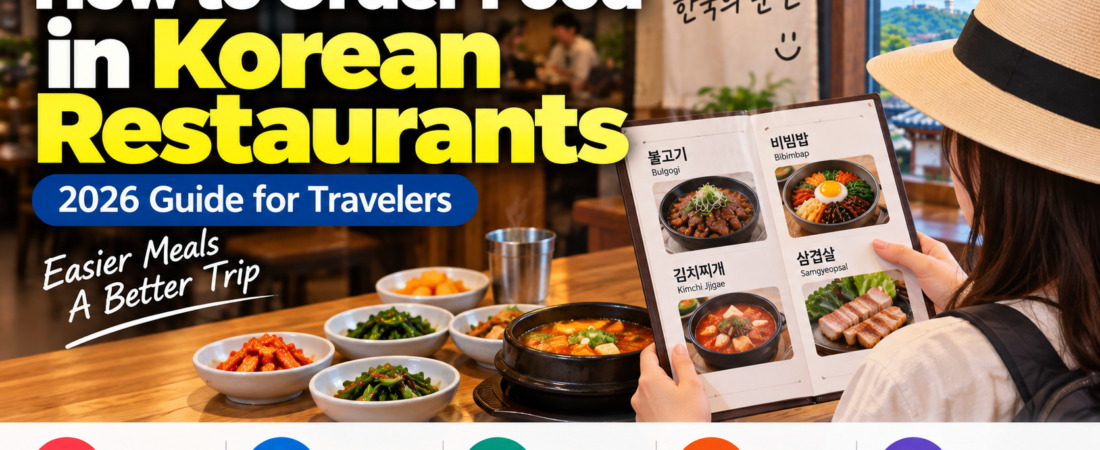
Eating at a local restaurant is one of the best parts of traveling in Korea, but the ordering process can feel unfamiliar if it is your first visit.
Some restaurants take orders at the table, others use kiosks or tablets, and some expect customers to order and pay at the counter.
This guide explains how to order food in Korean restaurants, including menus, kiosks, call buttons, side dishes, payment, and common situations travelers may encounter.
Is Ordering Food in Korea Difficult for Foreign Travelers?
Usually, no.
Many restaurants in popular tourist areas are accustomed to international visitors. However, the ordering system can vary significantly from one restaurant to another.
You may encounter:
- Table service
- Counter ordering
- Self-service kiosks
- Tabletop ordering tablets
- QR-based menus
- Restaurants where staff take your order verbally
The easiest approach is to look at what other customers are doing when you enter.
Check the Menu Before Ordering
Some Korean restaurants provide English menus, while others may only have Korean menus.
Restaurants in major tourist districts are more likely to have photos, English translations, or digital menus, but this is not guaranteed.
If the menu is difficult to understand, a translation app or camera translation feature can be useful.
It can also help to search the restaurant on a Korean navigation app before visiting.
Our
Naver Map guide for travelers
explains how to find restaurants, addresses, and nearby places in Korea.
How to Order at a Korean Restaurant

The basic process depends on the restaurant.
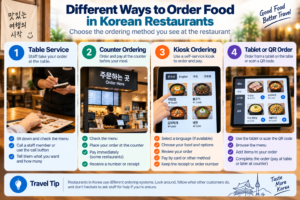
1. Table Service
At a traditional table-service restaurant, sit down and look through the menu.
When you are ready to order, you may call a staff member or use a call button if one is provided.
Tell the staff which dishes you want and how many servings you need.
2. Counter Ordering
Some cafés, fast-casual restaurants, noodle shops, and small restaurants ask customers to order at the counter.
You may need to pay immediately when placing your order.
After ordering, you may receive a number, receipt, pager, or pickup instructions.
3. Kiosk Ordering
Self-service kiosks are increasingly common in Korea.
The exact design varies, but the process usually looks like this:
- Select a language option if one is available.
- Choose your food and drinks.
- Select any required options.
- Review your order.
- Choose a payment method.
- Complete the payment.
- Keep the receipt or order number if provided.
Not every kiosk has the same language or payment options, so ask staff for help if you cannot complete the order.
What Is the Call Button on the Table?
Many Korean restaurants have a small call button on or near the table.
Pressing it alerts the staff that you need assistance.
You can use it when you want to:
- Place an order
- Order more food
- Request something from the staff
- Ask for the bill or payment instructions
VISITKOREA specifically highlights table call buttons as a common convenience found in Korean restaurants.
For general information about dining in Korea, see the
official VISITKOREA Korean food guide
.
Where Are the Spoons and Chopsticks?
If you do not see utensils on the table, look underneath or along the side of the tabletop.
Many Korean restaurants have a drawer built into the table where spoons, chopsticks, and napkins are stored.
Other restaurants may place utensils in a container on the table or bring them with the food.
Do not worry if you cannot use metal chopsticks comfortably. A spoon is commonly used for rice and soup.
What Is Banchan?

Banchan refers to the small side dishes commonly served with Korean meals.
Depending on the restaurant, these may include:
- Kimchi
- Seasoned vegetables
- Pickled radish
- Bean sprouts
- Other small side dishes
The exact selection depends on the restaurant and the main dish.
VISITKOREA explains that banchan are an important part of a traditional Korean meal and are eaten together with rice and other dishes.
Can You Ask for More Banchan?
At many Korean restaurants, basic side dishes can be refilled without an additional charge.
VISITKOREA also notes that requests for additional water or side dishes generally do not require an extra payment.
However, restaurant policies and the type of side dish can vary, so do not assume that every additional item on the table is unlimited.
Some restaurants operate a self-service station where customers can refill basic side dishes and water themselves.
What Does “Self” Mean in a Korean Restaurant?
You may see the English word SELF or the Korean word 셀프 displayed inside a restaurant.
This usually means customers are expected to get certain items themselves.
The self-service area may contain:
- Water
- Extra side dishes
- Utensils
- Napkins
- Cups
VISITKOREA notes that self-service systems for water and side dishes have become increasingly common in Korean restaurants. 1
Do You Need to Order One Dish Per Person?
There is no single rule that applies to every restaurant.
Some restaurants allow dishes to be shared freely, while others have minimum-order requirements.
This is especially important at restaurants serving Korean barbecue, set menus, hot pots, or dishes priced by the number of people.
Always check the menu or restaurant policy before ordering.
If the menu says a minimum number of servings is required, you will need to follow that restaurant’s rule.
How Do You Order Korean Barbecue?
Korean barbecue restaurants can work differently from ordinary restaurants.
Meat may be priced by portion, weight, or number of servings.
Depending on the restaurant, staff may:
- Cook the meat for you
- Start the grill and let you cook it yourself
- Replace the grill plate during the meal
- Bring lettuce, sauces, garlic, and side dishes automatically
If you are unsure whether you should cook the meat yourself, wait briefly and watch what the staff does.
Can You Order Food for One Person?
Yes, many restaurants serve solo diners, especially cafés, noodle restaurants, soup restaurants, convenience-style restaurants, and casual eateries.
However, not every restaurant is designed for solo dining.
Some barbecue, hot-pot, or shared-dish restaurants may require a minimum order that makes them less convenient for one traveler.
Checking the menu before traveling to the restaurant can save time.
Do You Pay at the Table or Counter?
Both systems exist.
In many restaurants, customers pay at a register near the entrance when they finish eating.
Other restaurants require payment when ordering, particularly at kiosks, cafés, and counter-service restaurants.
A smaller number of restaurants may provide table payment.
If you are unsure, watch other customers or ask the staff.
Can Foreign Credit Cards Be Used?
International credit cards are widely useful during travel in Korea, but acceptance can vary by restaurant and payment terminal.
It is useful to have more than one payment option available.
For a detailed explanation of cards, cash, mobile payments, and transportation payments, see our
How to Pay in Korea guide
.
Do You Tip at Restaurants in Korea?
Standard restaurant tipping is not generally expected in Korea.
VISITKOREA’s official guidance also states that tipping is not required or expected at Korean restaurants. 2
You normally pay the amount shown on your bill without adding a separate percentage for service.
How Do You Ask for Water?
Water may already be on the table, brought by the staff, or available at a self-service station.
If you cannot find it, you can ask a staff member.
A useful Korean phrase is:
Mul juseyo (물 주세요) — “Water, please.”
You do not need to memorize Korean phrases to eat at restaurants, but knowing a few simple words can make the experience easier.
Useful Korean Restaurant Phrases
| Korean | Pronunciation | Meaning |
|---|---|---|
| 이거 주세요 | Igeo juseyo | This one, please |
| 물 주세요 | Mul juseyo | Water, please |
| 감사합니다 | Gamsahamnida | Thank you |
| 안 매운 거 있어요? | An maeun geo isseoyo? | Do you have something not spicy? |
Showing the menu item on your phone or pointing to a menu photo can also work when language is difficult.
What If You Have a Food Allergy?
Travelers with serious food allergies should not rely only on pictures or assumptions.
Korean dishes may contain ingredients that are not visually obvious, including seafood-based seasonings, soy products, sesame, nuts, or other ingredients.
Prepare your allergy information clearly in Korean before visiting restaurants.
If staff cannot confidently confirm the ingredients or preparation method, choosing another dish or restaurant may be safer.
Can You Take Leftover Food Away?
Takeaway policies vary by restaurant and dish.
Some restaurants may provide a container, while others may not offer takeaway for leftovers.
Foods that require careful temperature control may also be unsuitable for carrying around for long periods.
Ask the restaurant rather than assuming that leftover food can always be packed.
How Are Restaurant Reservations Different From Ordering?
At popular restaurants, you may need to reserve a table or join a waitlist before you ever reach the ordering stage.
International travelers can use services such as CATCHTABLE Global at participating restaurants.
Our
Restaurant Reservations in Korea guide
explains reservations, remote waitlists, deposits, and CATCHTABLE Global.
VISITKOREA’s current CATCHTABLE information also confirms that the international service is designed to help foreign visitors reserve restaurants and join supported waitlists without requiring a Korean phone number. 3
Common Mistakes Travelers Make in Korean Restaurants
- Sitting down before checking whether you should order at the counter
- Ignoring kiosk or tablet instructions
- Assuming every restaurant has an English menu
- Not noticing a self-service water or side-dish station
- Waiting for staff instead of using the call button
- Assuming every restaurant accepts the same payment methods
- Ignoring minimum-order requirements
- Assuming all side dishes or additional items are unlimited
Korean Restaurant Quick Checklist
When you enter:
- Check whether you should wait to be seated
- Look for a counter, kiosk, or table-order system
- Confirm the menu and prices
When ordering:
- Check minimum-order requirements
- Select any required options
- Use the call button if needed
During the meal:
- Look for self-service water or side dishes
- Check the table drawer for utensils
- Ask before assuming an extra item is free
When leaving:
- Check whether payment is at the counter
- Take your belongings
- Confirm your card or receipt if needed
Final Thoughts
Learning how to order food in Korean restaurants is easier once you understand the basic systems.
You may order from staff, at a counter, through a kiosk, or from a tablet depending on the restaurant.
Call buttons, table drawers, banchan, and self-service areas may feel unfamiliar at first, but they are designed to make dining more convenient.
Check how each restaurant operates, keep a translation tool available, and do not hesitate to ask staff for help when you are unsure.
For more background on dining culture and Korean food, visit the
official VISITKOREA Korean food guide
.