
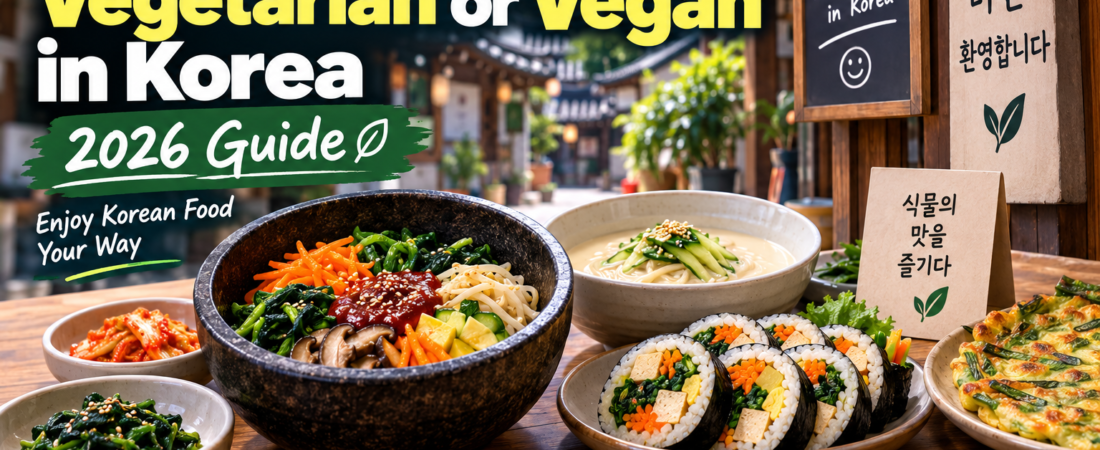
Finding vegetarian and vegan food in Korea is much easier when you know what to look for.
At first glance, Korean cuisine can seem very vegetarian-friendly. Rice, vegetables, tofu, noodles, kimchi, and vegetable side dishes appear everywhere.
However, a dish that looks meat-free is not necessarily vegetarian or vegan. Meat or seafood broth, fish sauce, salted seafood, eggs, and other animal-derived ingredients may be used even when they are not obvious on the plate.
For travelers, the key is not simply finding dishes with vegetables. It is learning how to explain your diet, check ingredients, and recognize foods that may need to be modified.
Is It Easy to Eat Vegetarian or Vegan in Korea?
It is possible, but the experience depends heavily on where you eat.
Dedicated vegetarian and vegan restaurants are the easiest option because their menus are designed around dietary restrictions.
At ordinary Korean restaurants, however, vegetarian requests may require more explanation.
VISITKOREA notes that Korean dishes are often prepared with meat or fish broth and that many restaurants do not have separate vegetarian menus.
This is why clearly explaining what you do and do not eat is important.
What Is the Difference Between Vegetarian and Vegan?
The exact definition can vary from person to person, so telling restaurant staff only that you are “vegetarian” may not provide enough information.
A vegetarian may avoid meat and seafood while still eating eggs or dairy products.
A vegan generally avoids animal-derived foods, including:
- Meat
- Fish and seafood
- Eggs
- Milk
- Cheese
- Butter
- Other animal-derived ingredients
If your diet is strict, explaining the individual ingredients you cannot eat is safer than relying only on a dietary label.
Why Can Korean Food Be Difficult for Vegetarians?
The challenge is often not the main ingredient.
A vegetable or tofu dish may still be prepared with:
- Beef broth
- Pork broth
- Anchovy broth
- Seafood broth
- Fish sauce
- Salted seafood
- Egg
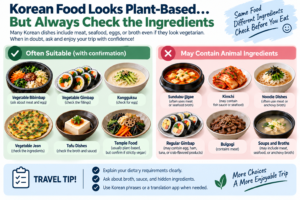
These ingredients may be part of the broth, sauce, seasoning, or garnish rather than something clearly visible.
Therefore, choosing a dish simply because you cannot see meat is not enough for a strict vegetarian or vegan diet.
How Do You Tell a Restaurant You Are Vegetarian?
A useful phrase is:
저는 채식주의자예요.
Jeoneun chaesikjuuijayeyo.
I am vegetarian.
However, this sentence alone may still leave questions about eggs, dairy, seafood, or broth.
For a strict diet, it is better to explain the ingredients you cannot eat.
How Do You Say You Are Vegan in Korean?
You can say:
저는 비건이에요.
Jeoneun bigeonieyo.
I am vegan.
Because not everyone may interpret the word “vegan” in exactly the same way, follow it with specific restrictions when necessary.
For example:
고기, 생선, 계란, 우유를 먹지 않아요.
Gogi, saengseon, gyeran, uyureul meokji anayo.
I don’t eat meat, fish, eggs, or milk.
How Do You Ask About Meat or Fish Broth?
This can be particularly important in Korea.
You can ask:
고기나 생선 육수가 들어가요?
Gogina saengseon yuksuga deureogayo?
Does this contain meat or fish broth?
If avoiding seafood is important, make that restriction clear rather than assuming a vegetable dish uses vegetable broth.
Is Bibimbap Vegetarian?
Not automatically.
Bibimbap is rice mixed with vegetables and sauce, which makes it look like an obvious vegetarian choice.
However, standard versions can include meat and egg.
VISITKOREA specifically advises vegetarian travelers to request that these ingredients be removed when necessary.
Also check how any accompanying soup, sauce, or side dishes are prepared.
How Do You Order Bibimbap Without Meat?
You can say:
고기 빼 주세요.
Gogi ppae juseyo.
Please leave out the meat.
If you also avoid eggs:
고기하고 계란 빼 주세요.
Gogihago gyeran ppae juseyo.
Please leave out the meat and egg.
Strict vegans should still confirm the other ingredients rather than assuming that removing the visible meat and egg makes the entire meal vegan.
Is Gimbap Vegetarian?
Some versions can be made vegetarian, but ordinary gimbap should not automatically be considered vegetarian.
Depending on the type, fillings can include:
- Egg
- Ham
- Tuna
- Crab-flavored products
- Cheese
Look for a clearly labeled vegetable or vegan version, or ask which ingredients are included.
Is Kimchi Vegetarian or Vegan?
Do not assume that all kimchi is vegetarian or vegan.
Traditional kimchi recipes may contain fish sauce or salted seafood.
Recipes vary, and vegan versions are also available.
If you follow a strict vegan diet, ask about the ingredients or choose a product clearly labeled as vegan.
Is Tofu Always Vegan?
Plain tofu itself may fit a vegan diet, but the finished Korean dish may not.
For example, tofu can be served in a stew made with meat or seafood broth.
Toppings and sauces can also contain animal-derived ingredients.
Check the complete dish rather than judging it by the tofu alone.
Is Sundubu-jjigae Vegetarian?
Standard sundubu-jjigae should not be assumed to be vegetarian.
Although tofu is the main ingredient, many versions contain seafood, meat, egg, or animal-based broth.
Some restaurants offer vegetarian or vegan versions, but confirm the ingredients before ordering.
What About Korean Noodle Dishes?
Noodles themselves may appear vegetarian, but the broth and toppings are often the deciding factors.
For example, soup noodles can use anchovy, beef, or other broths.
Cold soybean noodles, known as kongguksu (콩국수), can be a useful option because the broth is soybean-based.
However, VISITKOREA notes that some restaurants may add egg as a garnish, so ingredients should still be checked before ordering.
What Korean Foods Are Easier to Adapt?
Depending on the restaurant and recipe, possible options may include:
- Bibimbap without meat or egg
- Vegetable gimbap with ingredients confirmed
- Kongguksu with garnish checked
- Vegetable-based jeon with ingredients confirmed
- Tofu dishes prepared without animal-based broth or sauce
- Temple food
These are possibilities, not guarantees.
The recipe should still be checked when following a strict diet.
What Is Korean Temple Food?
Korean temple food developed within Buddhist temple culture.
It emphasizes vegetables, grains, mushrooms, fermented foods, and natural seasonings.
Traditional temple cuisine generally avoids meat and fish as part of Buddhist practice.
It is therefore one of the most useful Korean food traditions for vegetarian travelers to know about.
Is Korean Temple Food Always Vegan?
Do not rely on the word “temple food” alone if you follow a strict vegan diet.
Official Korean tourism information describes traditional temple cuisine as excluding animal-based ingredients while noting dairy as an exception in its explanation.
Individual restaurants may also adapt traditional recipes for general customers.
For strict vegan requirements, confirm the ingredients directly with the restaurant.
Where Can You Find Vegetarian and Vegan Restaurants?
Dedicated vegetarian and vegan restaurants are most common in major cities and popular tourist districts.
Instead of relying only on English searches, try several search terms in Korean map apps.
Useful searches include:
- 비건 — vegan
- 비건 식당 — vegan restaurant
- 채식 — vegetarian
- 채식 식당 — vegetarian restaurant
- 사찰음식 — temple food
For help using Korean map apps, see our
Naver Map and Google Maps in Korea guide
.
Can You Trust a Restaurant’s Vegan Label?
A clearly designated vegan restaurant or menu is generally easier for travelers with strict requirements.
However, recipes and menus can change.
If avoiding a particular ingredient is medically or personally essential, confirm it directly with the restaurant.
Can Convenience Stores Help?
Convenience stores can be useful for simple foods, but packaged products require label checking.
Products that appear plant-based may contain milk, egg, seafood seasoning, or other animal-derived ingredients.
Look for clearly identified vegan products where available and check the ingredient and allergen information.
For general convenience-store information, see our
Convenience Stores in Korea guide
.
What About Bakeries and Cafés?
Bread and desserts should not automatically be considered vegan.
Common ingredients include:
- Milk
- Butter
- Egg
- Cream
- Cheese
Some cafés and bakeries offer specifically labeled vegan products.
If there is no clear label, ask staff rather than guessing from the appearance.
How Do You Ask Whether Something Contains Egg?
Say:
계란 들어가요?
Gyeran deureogayo?
Does it contain egg?
How Do You Ask Whether Something Contains Milk?
Say:
우유 들어가요?
Does it contain milk?
How Do You Ask for an Ingredient to Be Removed?
A useful pattern is:
___ 빼 주세요.
___ ppae juseyo.
Please leave out ___.
Examples:
- 고기 빼 주세요. — Please leave out the meat.
- 계란 빼 주세요. — Please leave out the egg.
- 치즈 빼 주세요. — Please leave out the cheese.
Remember that removing a topping does not necessarily change ingredients already used in a broth or sauce.
Should You Use a Translation App?
Yes, especially if your dietary restrictions are strict.
VISITKOREA recommends preparing translated phrases that clearly explain what you cannot eat.
A written message can be easier to understand in a busy restaurant than trying to explain a complicated diet verbally.
Consider saving the message on your phone before your trip.
A Useful Message to Show Restaurant Staff
If you are vegan, you can prepare a message such as:
저는 비건입니다. 고기, 생선, 해산물, 계란, 우유와 유제품을 먹지 않습니다. 육수나 소스에도 들어가면 안 됩니다.
I am vegan. I do not eat meat, fish, seafood, eggs, milk, or dairy products. These ingredients also cannot be included in the broth or sauce.
Adapt this message to your actual dietary requirements.
What If the Restaurant Cannot Modify the Dish?
Do not assume every restaurant can change its recipes.
Broths, sauces, marinades, and prepared side dishes may already have been made earlier in the day.
If staff tell you that a dish cannot be modified, choosing another dish or restaurant is usually easier than repeatedly requesting changes.
Are Korean Side Dishes Vegetarian?
Not necessarily.
Even vegetable-based banchan can contain seafood seasoning, fish sauce, or other ingredients that do not fit a vegetarian or vegan diet.
Ask if you are uncertain rather than assuming every vegetable side dish is suitable.
Can You Eat at an Ordinary Korean Barbecue Restaurant?
This can be difficult for strict vegetarians and vegans because meat is the main focus of the meal.
Although vegetables and side dishes may be available, ingredients and shared cooking surfaces can create additional concerns.
If avoiding animal products strictly, a dedicated vegetarian or vegan restaurant is generally simpler.
What About Cross-Contact?
Vegetarian and vegan restaurants are the easiest choice if shared cooking equipment is a concern.
Ordinary restaurants may prepare meat and plant-based dishes in the same kitchen.
If cross-contact matters to you, explain that requirement clearly before ordering.
For serious food allergies, dietary preference guidance is not a substitute for direct allergy communication with restaurant staff.
Useful Korean Phrases for Vegetarian and Vegan Travelers

| Korean | Meaning |
|---|---|
| 저는 채식주의자예요. | I am vegetarian. |
| 저는 비건이에요. | I am vegan. |
| 고기 들어가요? | Does this contain meat? |
| 생선 들어가요? | Does this contain fish? |
| 계란 들어가요? | Does this contain egg? |
| 우유 들어가요? | Does this contain milk? |
| 고기나 생선 육수가 들어가요? | Does this contain meat or fish broth? |
| 고기 빼 주세요. | Please leave out the meat. |
Common Mistakes Vegetarian and Vegan Travelers Make
- Assuming a vegetable dish is automatically vegetarian
- Checking visible toppings but forgetting about broth
- Assuming all kimchi is vegan
- Assuming tofu dishes are automatically vegan
- Ordering ordinary gimbap without checking the fillings
- Using only the word “vegetarian” without explaining restrictions
- Assuming every temple-food restaurant follows exactly the same recipe rules
Quick Checklist Before Ordering
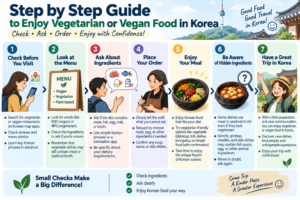
- Check whether the restaurant has a vegetarian or vegan menu
- Explain exactly which ingredients you avoid
- Ask about broth and sauces
- Check eggs and dairy if necessary
- Use a translation app when communication is difficult
- Do not assume vegetable dishes are automatically vegan
- Save a Korean dietary message on your phone
Final Thoughts
Finding vegetarian and vegan food in Korea is possible, and travelers now have more options than they may expect.
The biggest challenge is understanding ingredients that are not immediately visible.
A bowl filled with vegetables may still contain meat or seafood broth, while kimchi, tofu dishes, noodles, and gimbap can all require additional checking.
Dedicated vegetarian and vegan restaurants are the simplest option, while Korean temple food can provide another useful way to explore plant-focused Korean cuisine.
When eating at an ordinary restaurant, clearly explain what you cannot eat rather than relying only on the words “vegetarian” or “vegan.”
With a few Korean phrases and some ingredient checking, enjoying Korean food while following a vegetarian or vegan diet becomes much easier.