
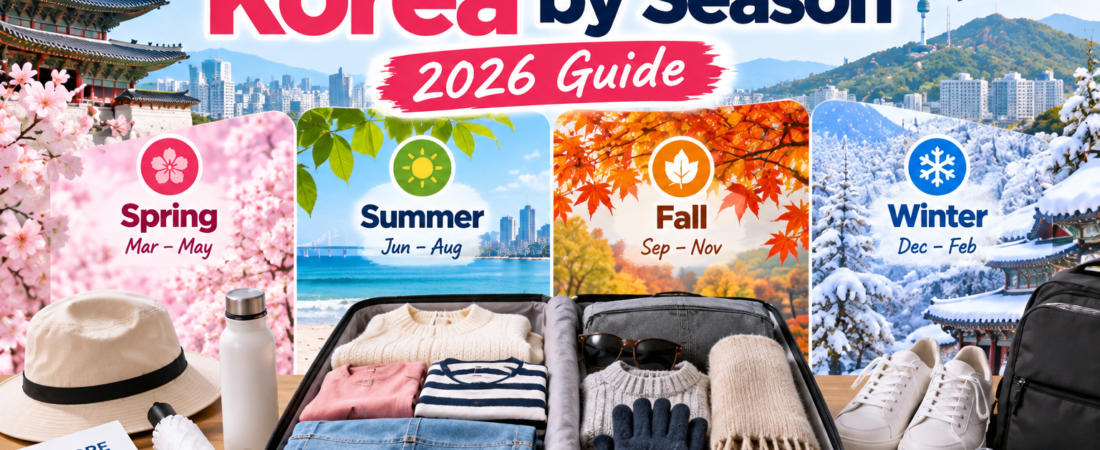
Knowing what to pack for Korea by season can make a major difference to your trip.
Korea has four distinct seasons, and the weather you experience in January can be completely different from the weather in July.
Spring and fall are generally milder, summer is hot and humid, and winter can become very cold and dry.
The month also matters. Early March can still feel cold, while September can remain warm after summer.
This guide gives you a practical overview of what to bring in each season so you can build your packing list before traveling to Korea.
What Is the Weather Like in Korea?
Korea is located in the temperate zone and has four distinct seasons.
According to official Korean tourism information, the general seasonal pattern is:
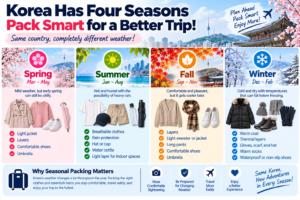
- Spring: generally mild, but early spring can still be chilly
- Summer: hot and humid with periods of heavy rain
- Fall: generally mild and comfortable, becoming cooler later in the season
- Winter: cold and dry with temperatures that can fall below freezing
Weather varies by location and year, so these patterns should be used as a starting point rather than a guaranteed forecast.
Quick Korea Packing Guide by Season
| Season | Months | Main Packing Priority |
|---|---|---|
| Spring | March–May | Layers and a light jacket |
| Summer | June–August | Breathable clothes and rain protection |
| Fall | September–November | Layers and comfortable walking clothes |
| Winter | December–February | Warm outerwear and cold-weather accessories |
What to Pack for Korea in Spring
Spring in Korea generally runs from March through May.
It is a popular season for outdoor sightseeing and spring flowers, but travelers should not assume that the entire season is warm.
Official tourism guidance notes that chilly weather can continue until around mid-March.
Temperatures then become progressively milder as spring continues.
Spring Packing Essentials
- Light or medium-weight jacket
- Long-sleeve shirts
- T-shirts for layering
- Long pants
- Comfortable walking shoes
- Compact umbrella
- Light sweater or cardigan
Layering is especially useful because mornings and evenings can feel much cooler than the middle of the day.
What Should You Wear in March?
March is a transition month.
Do not pack as though spring automatically means warm weather.
A jacket and layers are particularly useful in early and mid-March, especially if you plan to spend a lot of time outdoors.
What About April and May?
April and May are generally milder, making them comfortable months for walking and sightseeing.
You may be able to wear lighter clothes during the day, but keeping a light outer layer in your bag is still useful.
What to Pack for Korea in Summer
Summer generally runs from June through August.
Korean summers can be hot and humid, particularly during July and August.
Rain is another important consideration.
Korea’s summer rainy period typically affects part of the season, and official tourism guidance recommends checking weather forecasts carefully when traveling from late June through late July.
Summer Packing Essentials
- Lightweight T-shirts
- Breathable tops
- Shorts or lightweight pants
- Comfortable shoes
- Compact umbrella
- Light rain protection
- Hat or cap
- Reusable water bottle
- Thin layer for air-conditioned indoor spaces
Do You Need an Umbrella in Korea?
It is a useful item during summer.
Heavy rain can occur, and a small folding umbrella is easy to keep in a day bag.
If significant rain is forecast, a lightweight rain jacket or other rain protection can also be useful.
What Is Korea’s Rainy Season?
Korea’s summer rainy period is commonly known as jangma (장마).
The Korea Meteorological Administration describes it as part of the East Asian monsoon system.
Its exact start, end, and rainfall intensity vary from year to year.
For this reason, travelers should check the latest forecast instead of planning around a fixed rainy-season date.
What About Typhoons?
Typhoons can affect Korea during the warmer part of the year.
Official tourism information advises travelers to pay attention to typhoon and heavy-rain advisories during summer travel, with typhoon influence possible between June and October.
This does not mean your trip will experience a typhoon.
It means checking current weather warnings becomes more important during this period.
What to Pack for Korea in Fall
Fall generally runs from September through November.
It is often one of the most comfortable seasons for outdoor sightseeing.
However, September and November can feel very different.
September may still have warm days, while November can become noticeably cold.
Fall Packing Essentials
- T-shirts
- Long-sleeve shirts
- Light sweater
- Jacket
- Long pants
- Comfortable walking shoes
- Compact umbrella
Layers become increasingly important as the season progresses.
What Should You Wear in September?
September can still feel warm, particularly earlier in the month.
Pack lighter clothes as well as an extra layer for cooler evenings or changing weather.
What About October?
October is generally well suited to walking and outdoor sightseeing.
A light jacket or sweater is useful, especially in the morning and evening.
What About November?
November is much closer to winter conditions.
Bring a warmer jacket and additional layers, particularly if you are visiting later in the month.
What to Pack for Korea in Winter
Winter generally runs from December through February.
This is the season when packing appropriately becomes particularly important.
Official tourism information describes Korean winters as cold and dry, with temperatures frequently falling below freezing.
Winter Packing Essentials
- Warm winter coat
- Thermal base layers
- Sweaters or fleece layers
- Long pants
- Warm socks
- Gloves
- Scarf
- Warm hat
- Comfortable winter footwear
Do You Really Need a Heavy Coat?
For midwinter travel, a proper winter coat is strongly recommended.
The official VISITKOREA climate guide notes that winter temperatures can frequently fall below freezing and recommends thick outerwear.
If you are visiting Seoul or inland areas in January, prepare for genuinely cold outdoor conditions rather than mild winter weather.
Do You Need Thermal Underwear?
It is not mandatory, but thermal base layers can make long outdoor sightseeing days much more comfortable.
They are especially useful if you plan to visit:
- Outdoor palaces
- Traditional villages
- Mountains
- Ski resorts
- Outdoor markets
What Shoes Are Best in Winter?
Choose comfortable footwear with useful traction.
Snow and ice can make some sidewalks, palace paths, and slopes slippery.
You do not necessarily need specialized snow boots for an ordinary city trip, but shoes with very smooth soles can be inconvenient when surfaces are icy.
Are Seoul and Busan the Same Temperature?
No.
There can be meaningful regional differences.
Official climate data published by VISITKOREA shows that Busan generally has milder winter temperatures than Seoul.
This means a packing list for a winter trip focused on Seoul may need to be warmer than one for a trip focused mainly on southern coastal areas.
Always check the forecast for the actual cities on your itinerary.
What About Jeju Island?
Jeju has its own coastal and island weather characteristics.
Conditions can also vary between the coast and higher elevations.
Do not use Seoul’s forecast as a substitute for Jeju’s forecast.
If your itinerary includes multiple regions, check each destination separately before packing.
What Clothes Are Useful in Every Season?
Regardless of when you visit Korea, a few items are consistently useful:
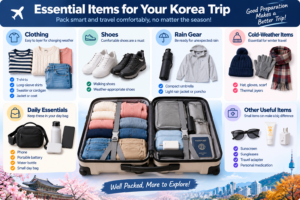
- Comfortable walking shoes
- Easy-to-layer clothing
- Light day bag
- Compact umbrella
- Extra socks
- Clothing suitable for long sightseeing days
Travelers often walk much more than expected when using public transportation and exploring neighborhoods.
What Shoes Should You Pack for Korea?
Comfort should be the priority.
A typical sightseeing day can involve subway stations, stairs, palace grounds, markets, shopping streets, and long walks between attractions.
Bring shoes that you have already worn comfortably rather than relying entirely on a new pair.
Should You Pack for Indoor Heating and Air Conditioning?
Yes.
Indoor temperatures can feel very different from outdoor conditions.
During summer, air-conditioned spaces may feel cool compared with the hot and humid outdoors.
During winter, heated indoor spaces can feel warm compared with freezing outdoor temperatures.
Layers make it easier to adjust throughout the day.
Should You Bring Rain Gear?
A compact umbrella is one of the easiest travel items to carry.
It becomes particularly useful during summer, but unexpected rain can occur in other seasons as well.
For days with prolonged or heavy rain, additional rain protection may be more practical.
Should You Pack Everything From Home?
Not necessarily.
Korea has convenience stores, pharmacies, supermarkets, department stores, and clothing shops where many everyday items can be purchased after arrival.
However, travelers who require a particular size, brand, prescription item, or specialized product should bring it rather than assuming an exact replacement will be easy to find.
For convenience-store basics, see our
Convenience Stores in Korea guide
.
What Should Go in Your Day Bag?
Your day bag will change with the season, but useful items can include:
- Phone
- Portable battery
- Wallet
- Transportation card
- Water
- Compact umbrella
- Small extra layer
In summer, prioritize heat and rain preparation.
In winter, prioritize warmth.
What Should You Check Before Your Flight?
Do not finalize your suitcase based only on the word “spring,” “summer,” “fall,” or “winter.”
Check the weather forecast for your destinations shortly before departure.
Pay attention to:
- Daily high temperatures
- Nighttime low temperatures
- Rain probability
- Heavy-rain advisories
- Typhoon information when relevant
- Cold-wave conditions in winter
Official tourism guidance specifically recommends checking real-time weather because weather patterns can vary and extreme conditions may occur.
Should You Check the Forecast Again After Arriving?
Yes.
A forecast you checked several days before your flight may change.
Check again each evening or morning when weather could affect your plans.
This is especially useful for outdoor attractions, hiking, beaches, festivals, and long day trips.
Common Packing Mistakes for Korea
- Assuming March is already warm
- Underestimating summer humidity
- Ignoring summer rain
- Assuming September is already cool
- Underpacking for winter
- Bringing uncomfortable shoes
- Packing only one type of clothing instead of layers
- Using Seoul weather for every destination in Korea
- Not checking the forecast shortly before departure
Quick Korea Packing Checklist
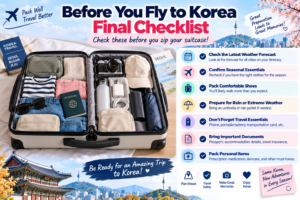
- Check your travel month
- Check every major destination on your itinerary
- Pack layers for temperature changes
- Bring comfortable walking shoes
- Prepare for rain when necessary
- Bring serious cold-weather clothing for winter
- Consider indoor heating or air conditioning
- Check the latest forecast before departure
Spring, Summer, Fall, or Winter: Which Packing Guide Do You Need?
This article is designed as an overview of what to pack for Korea by season.
If you are traveling during a specific season, a more detailed seasonal packing guide can help you prepare for monthly temperature changes, weather risks, footwear, sightseeing conditions, and day-trip essentials.
Our detailed seasonal guides will cover:
- What to Pack for Korea in Spring
- What to Pack for Korea in Summer
- What to Pack for Korea in Fall
- What to Pack for Korea in Winter
These guides can be used together with this page when planning your final packing list.
Final Thoughts
Knowing what to pack for Korea by season is less about creating one perfect packing list and more about preparing for the conditions you are likely to encounter.
Spring and fall are generally mild but still benefit from layers. Summer requires preparation for heat, humidity, and rain. Winter requires proper cold-weather clothing.
The beginning and end of each season can also feel very different, and conditions vary between regions such as Seoul, Busan, and Jeju.
Use this seasonal guide to build your basic suitcase, then check the current forecast shortly before departure.
That final weather check is often the most useful packing decision you can make.