
Fall is one of the most comfortable seasons to visit Korea, but packing for it is not as simple as bringing a sweater and a jacket.
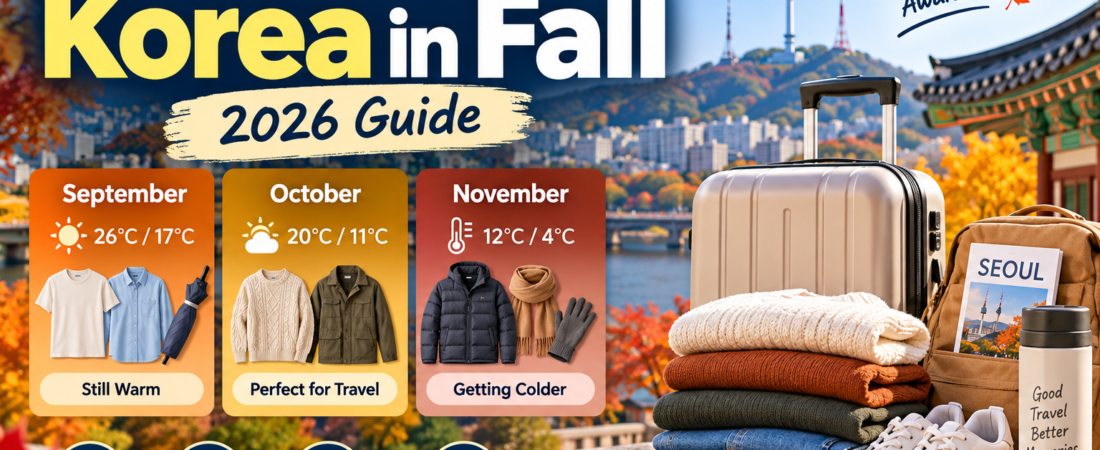
September can still feel surprisingly warm during the day, October usually brings the classic cool autumn weather travelers expect, and November can feel much closer to winter, especially in Seoul and northern parts of the country.
This guide explains what to pack for Korea in fall, with practical clothing and travel advice for September, October, and November.
If you are still deciding which season to visit, start with our broader What to Pack for Korea by Season guide. This article focuses only on fall and goes into much more detail about month-by-month clothing, shoes, rain preparation, and temperature changes.
Quick Answer: What Should You Pack for Korea in Fall?
For most fall trips to Korea, the best strategy is to pack clothes that can be layered rather than relying on one heavy outfit.
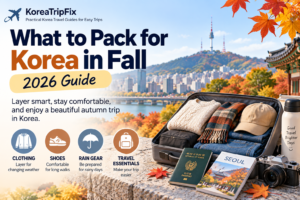
- Short-sleeve and long-sleeve tops
- A sweatshirt, cardigan, knit, or light fleece
- A light or medium-weight jacket
- Long pants
- Comfortable closed-toe walking shoes
- A compact umbrella or light rain shell
- Comfortable socks
- A small day bag
- Sunglasses and sun protection
- A warmer outer layer for November
Your exact packing list should depend heavily on the month. A traveler arriving in early September needs very different clothes from someone visiting in late November.
What Is Fall Weather Like in Korea?
Korea generally considers fall to run from September through November.
According to the official VISITKOREA climate guide, fall usually brings milder weather than summer, but temperatures change significantly over the three-month season.
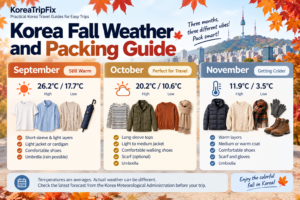
Here are the official long-term average high and low temperatures for Seoul and Busan:
| Month | Seoul High | Seoul Low | Busan High | Busan Low |
|---|---|---|---|---|
| September | 26.2°C | 17.7°C | 26.4°C | 19.8°C |
| October | 20.2°C | 10.6°C | 22.5°C | 14.5°C |
| November | 11.9°C | 3.5°C | 16.6°C | 8.3°C |
These are climate averages, not a forecast for your specific trip.
Actual temperatures can be warmer or colder, and recent years have shown noticeable year-to-year variation. Always check the Korea Meteorological Administration forecast shortly before departure.
What to Pack for Korea in September
One of the biggest packing mistakes travelers make is assuming that September in Korea automatically feels like cool autumn.
It often does not.
Average daytime highs in Seoul are still around 26°C, and warm or humid conditions can continue, particularly during the first part of the month.
For September, pack:
- Short-sleeve T-shirts
- One or two lightweight long-sleeve tops
- A thin cardigan or light jacket
- Lightweight trousers or jeans
- Breathable walking shoes or sneakers
- A compact umbrella
- A light rain jacket if you prefer not to carry an umbrella
You usually do not need a heavy fall coat for a typical September trip.
Instead, think of September as a transition between summer and autumn. Wear lighter clothes during the day and keep one thin outer layer available for cooler evenings, air-conditioned interiors, or changes in weather.
Do You Need Rain Gear in September?
It is sensible to carry a compact umbrella.
September can still receive meaningful rainfall, and Korea’s official tourism guidance notes that typhoons can occur during the broader June-to-October period.
This does not mean you should expect a typhoon during your trip. It simply means that checking the current weather forecast matters more than relying on seasonal averages.
What to Pack for Korea in October
October is the month most travelers imagine when they think of Korean autumn.
Days are generally cooler than September, evenings can feel noticeably chilly, and the temperature difference between daytime and nighttime becomes more important.
For October, pack:
- Long-sleeve T-shirts
- A sweatshirt, cardigan, or knit sweater
- A light to medium-weight jacket
- Jeans or other long pants
- Comfortable sneakers or walking shoes
- Several pairs of comfortable socks
- A compact umbrella
- A thin scarf if you get cold easily
Layering works especially well in October.
You might wear a T-shirt or long-sleeve shirt during the warmer part of the afternoon, then add a sweater or jacket after sunset.
What Kind of Jacket Is Best for October?
You usually do not need a thick winter coat for an ordinary October city trip.
A light jacket, trench coat, denim jacket, windbreaker, or similar mid-season outer layer is usually more practical because you can remove it during warmer parts of the day.
The Official Seoul Travel Guide also recommends adaptable autumn clothing such as sweatshirts and jackets because temperatures can change significantly during the day.
What to Pack for Korea in November
November is very different from September.
In Seoul, the official climate averages fall to around 11.9°C for the daytime high and 3.5°C for the nighttime low.
That means late-November visitors should prepare for conditions that may feel more like early winter than the colorful autumn weather shown in travel photos.
For November, pack:
- Long-sleeve tops
- Knit sweaters, sweatshirts, or fleece layers
- A medium-weight coat or light puffer jacket
- Long pants
- Warm socks
- Closed-toe walking shoes
- A scarf if you are sensitive to cold
- Thin gloves for colder days or nighttime outings
A heavy winter parka may be unnecessary for many early-November city trips, but by late November, a warmer coat can become much more useful.
Check the actual forecast instead of deciding based only on the word “fall.”
What Shoes Should You Wear in Korea in Fall?
Comfortable walking shoes are more important than stylish seasonal shoes for most travelers.
A normal sightseeing day in Seoul, Busan, Gyeongju, or another Korean city can involve long walks, subway stations, stairs, palace grounds, markets, and uneven outdoor surfaces.
Good options include:
- Comfortable sneakers
- Supportive walking shoes
- Light waterproof shoes if rain is expected
For city travel, hiking boots are generally unnecessary unless your itinerary actually includes hiking.
If you plan to hike Bukhansan, Seoraksan, or another mountain, choose footwear based on the specific trail and weather conditions rather than using ordinary city shoes automatically.
Do You Need Waterproof Shoes?
Not necessarily.
For most urban fall trips, ordinary comfortable sneakers are enough when the forecast is mostly dry.
If several rainy days are forecast, water-resistant shoes may be more convenient.
Avoid packing heavy waterproof boots just because you are traveling in autumn unless your activities or forecast justify them.
Should You Bring an Umbrella?
Yes, a small travel umbrella is useful, especially in September.
However, there is no reason to pack large amounts of rain equipment based only on the season.
Check the short-range forecast shortly before your trip.
The Korea Meteorological Administration short-range forecast provides current temperature and precipitation information that is far more useful for final packing decisions than historical averages.
Should You Pack for Hot Weather in Fall?
If you are visiting in September, yes.
Bring at least some lightweight clothing.
A September traveler who packs only sweaters and jackets may end up feeling uncomfortable during warmer afternoons.
By October, the balance shifts toward layers.
By November, cold-weather clothing becomes much more important, especially in Seoul and northern or mountainous areas.
Seoul vs Busan: Does the Packing List Change?
Yes, slightly.
Busan generally remains milder than Seoul during the later part of fall.
For example, official climate averages show a November low of about 3.5°C in Seoul compared with about 8.3°C in Busan.
This does not mean Busan is always warm. Wind near the coast can still make evenings feel chilly.
If your itinerary includes both Seoul and Busan, pack for the colder destination and use removable layers in the warmer one.
What If You Are Visiting the Mountains?
Mountain conditions can be significantly cooler than city-center temperatures.
If your fall itinerary includes places such as Seoraksan or other higher-elevation destinations, check the local forecast rather than using Seoul’s weather as a substitute.
Bring an additional warm layer and suitable footwear if your trip includes hiking or long periods outdoors.
What to Pack for Fall Foliage Trips
If the main purpose of your trip is autumn foliage, your packing needs may be slightly different from a city-only trip.
For 2026, VISITKOREA’s official 2026 fall foliage forecast expects peak foliage across much of Korea from approximately mid-October through early November.
The forecast includes peak dates such as October 25 for Seoraksan and early November for several other major foliage destinations, but the official guidance also warns that actual dates can change depending on weather conditions.
For foliage trips, consider packing:
- A removable warm layer
- A wind-resistant jacket
- Comfortable walking shoes
- A small backpack
- A water bottle
- A compact umbrella
- A portable phone battery
If you will be hiking rather than simply visiting an accessible foliage attraction, prepare for the specific trail separately.
Do You Need Dressy Clothes?
For most Korea sightseeing trips, no special dress code is required.
Clean casual clothing is suitable for most cafés, restaurants, shopping districts, museums, and tourist attractions.
If you have reservations at an upscale restaurant, business meeting, performance, or special event, check that venue’s dress expectations separately.
Also remember that some Korean homes and certain traditional indoor spaces require visitors to remove their shoes.
For more everyday behavior tips, see our Korea Travel Etiquette guide.
What Not to Overpack
Korea has convenience stores, clothing shops, pharmacies, department stores, and shopping malls throughout major cities, so you do not need to prepare for every possible weather situation with a completely separate outfit.
Try not to overpack:
- Multiple heavy coats
- Bulky hiking boots for a city-only trip
- Too many sweaters
- Large umbrellas
- Winter accessories for an early-September trip
Layering a smaller number of versatile clothes usually works better than carrying separate outfits for every temperature.
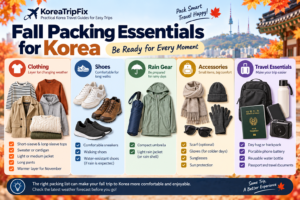
A Simple 7-Day Fall Packing Example
For a typical one-week fall trip, you could start with:
- 4 to 5 tops
- 2 to 3 pairs of pants
- 1 sweater or sweatshirt
- 1 jacket
- 1 pair of comfortable walking shoes
- Enough socks and underwear for your laundry plan
- 1 compact umbrella
- Sleepwear
For September, make more of the tops lightweight.
For October, increase the number of long sleeves and layers.
For November, replace the thin jacket with a warmer coat and add cold-weather accessories as needed.
Common Fall Packing Mistakes
Assuming All Three Fall Months Feel the Same
September and November can feel like completely different seasons.
Always pack for your actual travel dates.
Using Average Temperatures as a Forecast
Climate averages are useful for planning, but they cannot tell you the weather during your specific trip.
Check the latest official forecast a few days before departure.
Not Packing Layers
Fall often brings noticeable differences between daytime and nighttime temperatures.
A removable sweater or jacket is more useful than an outfit that only works at one temperature.
Choosing Fashion Over Walking Comfort
Travelers often walk more than expected in Korea.
Break in your shoes before the trip rather than bringing completely new footwear.
Packing a Winter Coat Too Early
A thick winter coat can be inconvenient during a warm September trip.
Check your month and current forecast before using valuable luggage space on bulky outerwear.
Quick Fall Packing Checklist
- Check whether your trip is in September, October, or November.
- Check Seoul, Busan, or your actual destination forecast.
- Pack removable layers.
- Bring comfortable walking shoes.
- Bring a compact umbrella.
- Prepare a warmer jacket for November.
- Add extra layers for mountain trips.
- Do not rely only on historical averages.
- Check the Korea Meteorological Administration forecast before departure.
Final Thoughts
The key to deciding what to pack for Korea in fall is understanding that Korean autumn changes quickly from September to November.
September often still needs lightweight clothing, October is ideal for flexible layers, and November can require a proper warm coat, especially in Seoul.
Comfortable shoes, a removable outer layer, and a compact umbrella will cover most ordinary fall sightseeing situations.
Most importantly, check the latest official weather forecast shortly before your flight. Seasonal averages are useful for planning, but the actual forecast should make the final decision about what goes into your suitcase.