

Travel insurance is one of those things you hope you never need during a trip to Korea.
But a sudden illness, accident, cancelled flight, stolen bag, or unexpected trip interruption can become expensive very quickly when you are far from home.
This Korea Travel Insurance guide explains what foreign tourists should check before buying a policy, which types of coverage are most useful in Korea, what travel insurance usually does not cover automatically, and what to do if an emergency happens during your trip.
This article is a practical travel guide, not insurance, legal, or medical advice. Coverage, exclusions, limits, deductibles, and claim rules vary by insurer and policy.
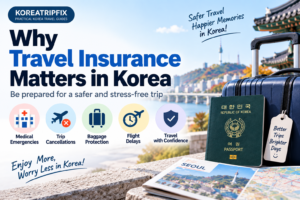
Quick Answer: Do You Need Travel Insurance for Korea?
Travel insurance can be useful for most international visitors to Korea, particularly if your existing health insurance does not cover treatment overseas.
However, do not assume that every traveler has the same insurance requirement.
Entry rules can vary depending on your nationality, visa type, and travel situation. Korea’s official K-ETA application guidance should be checked separately from your insurance decision.
You can check current entry information through the official K-ETA website.
For a complete entry overview, see our Korea Entry Requirements for Tourists in 2026 guide.
What Is Travel Insurance?
Travel insurance is designed to protect you financially against certain unexpected problems that happen before or during a trip.
Depending on the policy, coverage may include:
- Emergency medical treatment
- Emergency medical evacuation
- Repatriation
- Trip cancellation
- Trip interruption
- Flight or travel delays
- Delayed baggage
- Stolen or damaged belongings
- Personal liability
Not every policy includes all of these benefits.
Two travel insurance policies with similar prices can have very different coverage limits and exclusions, so the details matter more than the product name.
Does Korean National Health Insurance Cover Tourists?
Short-term travelers should not assume that they are automatically covered by Korea’s national health insurance system.
VISITKOREA’s official medical tourism guidance advises foreign patients who are not residents of Korea to contact their own medical provider or insurance company regarding international or travel insurance and the documents they may need.
VISITKOREA – Insurance Information for International Visitors
If you need medical care while traveling, do not assume that showing your passport automatically gives you the same health coverage as a Korean resident.
What Coverage Should You Check Before Traveling to Korea?
There is no single policy that is best for every traveler.
Instead, compare the areas that could cause the biggest financial problem for your particular trip.

1. Emergency Medical Coverage
Medical coverage is one of the most important parts of travel insurance.
Check whether the policy covers:
- Emergency outpatient treatment
- Hospitalization
- Diagnostic tests
- Prescription medication
- Emergency dental treatment, if included
- Ambulance-related expenses where applicable
Also check the maximum medical benefit and whether you must pay the hospital first and claim reimbursement later.
Some insurers can arrange direct payment with certain medical facilities, while others require the traveler to pay first.
2. Emergency Evacuation and Repatriation
Medical evacuation is different from ordinary medical treatment.
If a serious condition requires transportation to another hospital or country, costs can become very high.
Check whether your policy includes:
- Emergency medical transportation
- Medical evacuation
- Repatriation to your home country
- Repatriation of remains
These benefits are especially worth checking if your itinerary includes hiking, islands, rural areas, or activities far from major hospitals.
What Happens If You Have a Medical Emergency in Korea?
For a serious medical emergency in Korea, call 119.
Korea’s official government information states that 119 emergency services operate 24 hours a day, year-round, and foreign travelers are eligible to receive emergency medical services.
The government also states that the 119 ambulance service itself is provided free of charge. This does not mean that subsequent hospital treatment is free.
Foreign-language interpretation support may also be arranged, including coordination with the 1330 Korea Travel Hotline.
Korea.net – Emergency Medical Services in Korea
For a full list of emergency contacts, see our Emergency Numbers in Korea guide.
3. Trip Cancellation Coverage
Trip cancellation coverage can reimburse certain prepaid, non-refundable expenses if you have to cancel before departure for a reason covered by your policy.
Possible covered reasons vary widely.
Depending on the policy, they may include events such as:
- Serious illness or injury
- Death of certain family members
- Specific natural disasters
- Other events specifically listed in the policy
Simply changing your mind about a trip is usually not the same thing as a covered cancellation event.
Read the policy wording carefully before relying on cancellation coverage.
4. Trip Interruption Coverage
Trip interruption applies after your journey has already started.
For example, you may need to return home unexpectedly because of a covered event.
Depending on the policy, benefits can help with unused prepaid expenses or additional transportation costs.
Again, the exact reasons that qualify depend on the insurance contract.
5. Flight Delay and Missed Connection Coverage
Long international itineraries often involve connecting flights.
If a flight is delayed, travel insurance may cover certain additional expenses after the delay reaches the minimum period defined by the policy.
Possible benefits may include:
- Meals
- Hotel accommodation
- Local transportation
- Additional travel expenses
Do not assume that a short delay automatically qualifies for reimbursement.
Check the minimum delay time, benefit limit, and required documentation.
6. Baggage Delay Coverage
If an airline delays your checked baggage, some policies reimburse necessary purchases such as basic clothing or toiletries.
The coverage usually begins only after the baggage has been delayed for a specified amount of time.
Keep:
- The airline baggage report
- Your baggage claim tag
- Receipts for necessary purchases
- Flight documents
Do not buy expensive replacement items assuming that the insurance company will reimburse everything. Policies normally have benefit limits.
7. Lost, Stolen, or Damaged Belongings
Baggage coverage is one of the most misunderstood parts of travel insurance.
A policy may cover theft or accidental damage but treat ordinary loss, unattended belongings, cash, credit cards, expensive electronics, or jewelry differently.
Many policies also set a maximum payment per item.
Before traveling with an expensive camera, laptop, or other electronics, check the per-item limit rather than looking only at the total baggage coverage amount.
Loss and Theft Are Not Always the Same
This distinction is important.
If your bag is stolen, your insurer may require a police report.
If you simply leave an item somewhere and cannot find it again, the policy may classify the situation differently.
Never describe an ordinary loss as theft just to make an insurance claim.
Report the facts accurately and follow your insurer’s claim instructions.
8. Personal Liability Coverage
Some travel insurance policies include personal liability protection.
This may help if you accidentally injure another person or damage someone else’s property during a covered situation.
The types of incidents covered and the limits vary greatly by policy.
If liability protection matters to you, check the wording before buying.
Do Adventure Activities Need Extra Coverage?
Possibly.
Standard policies may exclude certain high-risk activities or require optional coverage.
This can matter if your Korean itinerary includes activities such as:
- Technical or high-altitude hiking
- Skiing or snowboarding
- Scuba diving
- Paragliding
- Motorcycling
- Other adventure sports
Do not assume that an activity is covered just because it is legal or commercially available in Korea.
Tell the insurer what you plan to do and check the policy terms.
What About Hiking in Korea?
Ordinary sightseeing and a demanding mountain hike are not necessarily treated the same way by insurers.
Korea has many popular hiking destinations, and some visitors underestimate how strenuous mountain conditions can become.
If hiking is a major part of your trip, check:
- Altitude restrictions
- Trail or mountaineering exclusions
- Search and rescue coverage
- Medical evacuation coverage
- Weather-related exclusions
What About Pre-Existing Medical Conditions?
This is one of the most important sections of any travel insurance policy.
Do not assume that a pre-existing medical condition is automatically covered.
Depending on the insurer, coverage may:
- Be included under specific conditions
- Require disclosure
- Require an additional premium
- Be excluded entirely
If you are unsure whether a health condition must be declared, ask the insurer before purchasing the policy.
Giving incomplete or inaccurate information can create problems during a claim.
Should You Buy Insurance Before or After Booking Your Trip?
Buying insurance soon after booking can be useful because some cancellation-related benefits apply only after the policy starts.
However, policy rules vary.
Before buying, check:
- When coverage officially begins
- When medical coverage begins
- Whether cancellation coverage starts immediately
- Whether there is a waiting period
- The final date by which you can purchase coverage
If you buy travel insurance after a known problem has already occurred, that event may not be covered.
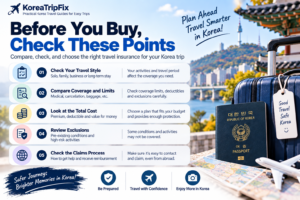
Should Your Policy Cover the Entire Trip?
Yes, check your dates carefully.
Your insurance period should normally include the entire journey you want covered, not just the nights you spend in a Korean hotel.
Consider:
- Your departure date from home
- International transit days
- Your full stay in Korea
- Your return journey
If your trip changes, contact the insurer to confirm whether the policy dates can be extended.
What If You Already Have Insurance Through a Credit Card?
Some credit cards include travel insurance, but the benefits can be very different from a separate travel policy.
Check whether coverage requires you to:
- Pay for the airfare with the card
- Pay a certain percentage of the trip with the card
- Activate the insurance before departure
- Meet other eligibility requirements
Also compare medical and evacuation limits carefully.
A card may provide useful benefits without providing all the protection you expect from comprehensive travel insurance.
What Documents Should You Save?
Do not wait for something to go wrong before learning how to make a claim.
Before leaving home, save:
- Your insurance policy number
- Emergency assistance phone number
- Insurer’s international contact details
- Policy certificate
- Coverage summary
- Claim instructions
Keep digital copies on your phone and in cloud storage that you can access from another device.
What Documents Might You Need for a Claim?
The required evidence depends on what happened.
Common examples include:
- Hospital bills
- Medical reports
- Prescription receipts
- Airline delay confirmation
- Baggage irregularity reports
- Police reports
- Purchase receipts
- Hotel invoices
- Original travel reservations
If an insurer has an emergency assistance line, contacting it early can help you understand what paperwork is required.
Do Not Throw Away Receipts
This is a simple mistake that can make a claim much harder.
If you spend money because of a medical problem, baggage delay, travel disruption, or other potentially covered event, keep the receipts until the claim is fully resolved.
Take photos of paper receipts as a backup.
Should You Contact the Insurer Before Going to a Hospital?
If the situation is life-threatening or urgent, seek emergency medical care first.
Call 119 in Korea for a medical emergency.
For a non-life-threatening situation, check your insurance policy because some insurers want travelers to contact their assistance center before certain treatments or hospital admissions.
Following the insurer’s instructions can make the payment and claim process easier.
Common Travel Insurance Mistakes
Buying the Cheapest Policy Without Reading It
A low price does not automatically mean poor coverage, but price alone tells you very little.
Compare coverage limits, deductibles, exclusions, and