
Credit cards are widely used in Korea, but having some Korean won in cash can still be useful during your trip.
You may need cash for certain transportation card transactions, small businesses, traditional markets, or situations where your foreign card does not work.
This guide explains how to withdraw cash in Korea, including where to find ATMs, how to recognize machines that may accept foreign cards, what to do when an ATM rejects your card, and how to avoid common withdrawal mistakes.
Do Tourists Need Cash in Korea?
You do not need to carry large amounts of cash for most trips.
VISITKOREA notes that credit cards are widely accepted at hotels, department stores, shops, and many other businesses in Korea.
However, card acceptance is not universal, and travelers may still encounter situations where cash is useful.
For a broader explanation of cards and cash, read our
How to Pay in Korea guide
.
Where Can You Find ATMs in Korea?
ATMs are common in major cities and tourist areas.
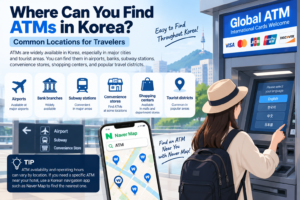
You may find them at:
- Airports
- Bank branches
- Subway stations
- Convenience stores
- Shopping centers
- Major tourist districts
Availability and operating hours vary by machine and location.
If you need a specific ATM near your hotel, using a Korean navigation app can make the search easier.
See our
How to Use Naver Map in Korea guide
.
Can Foreign Cards Be Used at Korean ATMs?
Some Korean ATMs accept foreign-issued cards, but not every ATM does.
Look for signs such as Global ATM, International Card, or international card-network logos on the machine.
Even when an ATM appears to support international cards, acceptance can still depend on your bank, card network, account settings, and the individual ATM.
If one machine rejects your card, trying a different bank or ATM is often more useful than repeatedly attempting the same withdrawal.
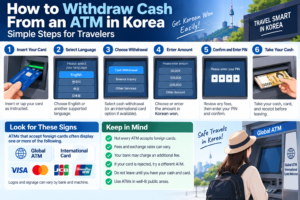
How to Withdraw Cash From an ATM in Korea
The exact screen varies by bank, but the general process is usually similar.
- Insert or tap your card as instructed.
- Select English or another supported language if available.
- Choose an international or foreign-card option if the ATM provides one.
- Select cash withdrawal.
- Choose or enter the amount in Korean won.
- Review any displayed fees or exchange information.
- Enter your PIN when requested.
- Confirm the transaction.
- Take your cash, card, and receipt.
Do not walk away until you have confirmed that you have your card and cash.
What Does “Global ATM” Mean?
A Global ATM generally refers to a machine designed to support additional international card services.
This can make it a better choice for foreign travelers than a machine designed only for domestic Korean cards.
However, the words “Global ATM” do not guarantee that every foreign card will work.
Always check the supported card-network logos on the ATM and your own card.
Can You Withdraw Cash at Incheon Airport?
Yes. Incheon International Airport has multiple bank ATMs and public ATMs in its passenger terminals.
The airport’s official facility directory currently lists ATMs from banks such as KB Kookmin Bank, Woori Bank, and Hana Bank, along with public ATM machines.
Some airport ATMs operate 24 hours, while others have limited operating hours.
Because locations and operating hours can change, check the
official Incheon International Airport facilities directory
before relying on a specific machine.
Should You Withdraw Cash at the Airport?
The airport is convenient if you want Korean won immediately after arriving.
It is not necessary to withdraw all the cash you expect to use during your entire trip at once.
A practical approach is to obtain enough money for your immediate needs and withdraw more later if necessary.
This also reduces the amount of cash you need to carry.
ATM Withdrawal vs Currency Exchange
ATM withdrawal and physical currency exchange are two different ways to obtain Korean won.
With an ATM, the final cost can depend on:
- The ATM operator’s fee
- Your bank’s foreign transaction or withdrawal fee
- Your card network’s exchange process
- The exchange rate applied to the transaction
With physical currency exchange, the rate and any commission depend on the bank or authorized exchange provider.
VISITKOREA recommends using banks or authorized money exchange service centers when exchanging foreign currency.
You can check the
official VISITKOREA currency and exchange information
for current general guidance.
Are There ATM Fees in Korea?
There may be.
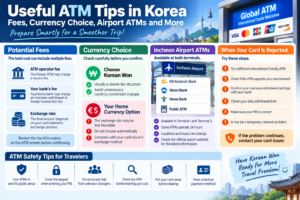
The total cost of a withdrawal can involve more than one type of fee.
The Korean ATM operator may charge a service fee, and your home bank may separately charge an overseas ATM or foreign transaction fee.
Because fees depend on the ATM and your card issuer, there is no single fee that applies to every traveler.
Review the ATM screen before confirming the transaction.
Should You Choose Korean Won or Your Home Currency?
Some payment terminals or ATMs may offer a choice involving your home currency.
Read the exchange-rate information carefully before accepting any currency-conversion option.
Do not choose an option automatically just because the amount is displayed in a familiar currency.
Your card issuer may use a different exchange method, so compare the information provided by your bank before traveling.
What If the ATM Rejects Your Card?
A rejected transaction does not necessarily mean your card is unusable in Korea.
Possible reasons include:
- The ATM does not support your international card network
- Your bank has blocked overseas cash withdrawals
- Your daily withdrawal limit has been reached
- The ATM has its own transaction limit
- Your PIN or account settings are incompatible
- A temporary network problem has occurred
Try another international-friendly ATM and contact your card issuer if the problem continues.
Should You Tell Your Bank Before Traveling?
Check your bank’s current overseas-use policy before your trip.
Some financial institutions no longer require travel notifications, while others provide security settings in their mobile apps.
Also check:
- Whether overseas ATM withdrawals are enabled
- Your daily cash withdrawal limit
- Your overseas ATM fee
- Emergency card support information
These rules are determined by your card issuer, not by Korea.
What If an ATM Keeps Your Card?
Stay near the machine and look for the ATM operator’s contact information.
If the ATM is located at a bank branch during business hours, ask bank staff for assistance.
If the ATM is located inside an airport, shopping center, or convenience store, staff may be able to help identify the ATM operator.
Contact your bank immediately if you cannot recover the card.
Can You Find ATMs at Convenience Stores?
Some Korean convenience stores have ATMs, but services vary by branch.
Not every convenience-store ATM accepts foreign cards.
Look for international card-network logos before using the machine.
Our
Convenience Stores in Korea guide
explains other useful convenience-store services for travelers.
How Much Cash Should You Withdraw?
There is no ideal amount for every traveler.
Your needs depend on your itinerary, payment habits, and whether you plan to visit places where cash is more useful.
Avoid carrying significantly more cash than you reasonably expect to need.
Keeping one primary card, a backup payment method, and a modest amount of Korean won gives you more flexibility.
Do You Need Cash for T-money?
Cash can still be important for some transportation-card transactions.
Payment options for purchasing or reloading transportation cards depend on the card, location, and machine being used.
Do not assume that an international credit card can be used for every T-money purchase or reload.
For current transportation-card information, see the
official VISITKOREA transportation card guide
.
You can also read our
How to Buy a T-money Card in Korea guide
.
Can You Exchange Foreign Cash Instead?
Yes.
If you already have foreign cash, you can use a bank or authorized money exchange service.
VISITKOREA states that banks in Korea generally operate around weekday banking hours, although hours vary by branch and region.
Airports also have currency exchange services for arriving and departing travelers.
VISITKOREA’s airport exchange guide notes that exchange counters at Incheon Airport have different locations and operating hours, so travelers should check current information before arrival.
See the
official VISITKOREA airport currency exchange guide
.
ATM Safety Tips for Travelers
Use normal travel precautions when withdrawing cash.
- Use ATMs in well-lit public areas
- Cover the keypad when entering your PIN
- Do not accept help from unknown strangers
- Check the ATM before inserting your card
- Put your cash away before leaving
- Keep your main card and backup card separately
- Save your bank’s international support number
Common ATM Mistakes in Korea
- Assuming every ATM accepts foreign cards
- Ignoring displayed ATM fees
- Repeatedly retrying the same rejected machine
- Withdrawing a large amount of cash unnecessarily
- Forgetting to collect the card after the transaction
- Relying on only one payment card
- Waiting until you urgently need cash before finding a compatible ATM
Korea ATM Quick Checklist
Before your trip:
- Enable overseas ATM withdrawals if required by your bank
- Check your withdrawal limit
- Check your bank’s overseas ATM fees
- Prepare a backup payment method
At the ATM:
- Look for international card support
- Select a supported language
- Review the amount and fees
- Protect your PIN
- Collect your cash and card
If the withdrawal fails:
- Do not repeatedly retry the same ATM
- Try another bank or Global ATM
- Check your banking app
- Contact your card issuer if necessary
Final Thoughts
Learning how to withdraw cash in Korea can prevent unnecessary stress during your trip.
Most travelers can pay by card for many everyday purchases, but carrying some Korean won remains useful.
Look for ATMs that support international cards, review fees before confirming the transaction, and keep more than one payment option available.
If one ATM does not accept your card, try another international-friendly machine rather than assuming your card will not work anywhere in Korea.
For current currency and exchange information, check
VISITKOREA’s official currency guide
before your trip.