
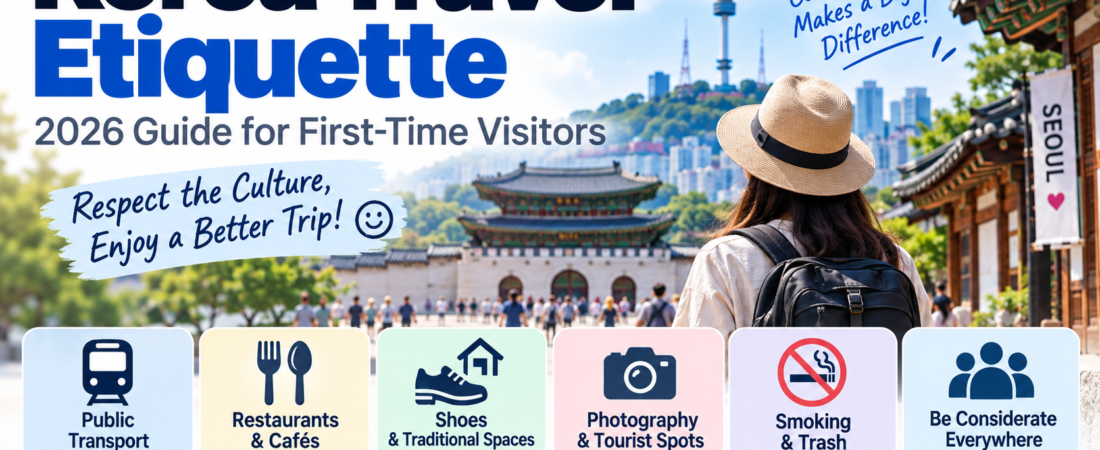
Visiting Korea for the first time can feel surprisingly easy. Public transportation is efficient, credit cards are widely accepted, and English signs are common in major tourist areas.
Still, knowing a few local customs can make your trip smoother and help you avoid uncomfortable situations.
Korea travel etiquette is generally not about memorizing complicated rules. Most of it comes down to being considerate in shared spaces, following posted instructions, and paying attention to what people around you are doing.
This guide covers the practical etiquette travelers are most likely to encounter on public transportation, in restaurants, cafés, hotels, traditional spaces, and popular tourist areas.
Is Korean Etiquette Difficult for Tourists?
No.
Foreign visitors are not expected to understand every Korean social custom.
For most travelers, a few basic habits are enough:
- Keep noise reasonable in shared spaces
- Respect priority seating
- Follow queues
- Check whether shoes should be removed
- Do not assume tipping is expected
- Follow photography and smoking rules
- Be considerate in residential and religious areas
If you are unsure what to do, observing how other people are using the space is often helpful.
Public Transportation Etiquette in Korea
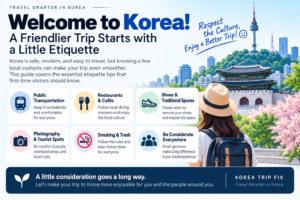
Subways and buses are heavily used in Korean cities, especially during commuting hours.
Try to:
- Let passengers exit before you board
- Move away from doors after boarding when possible
- Keep phone calls and videos quiet
- Avoid blocking aisles with luggage
- Follow signs and platform markings
- Give priority to passengers who need extra assistance
Rush-hour trains can become extremely crowded, so keeping backpacks and large luggage close to your body helps avoid blocking other passengers.
What Are Priority Seats?
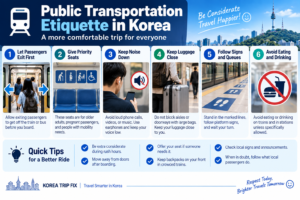
Korean subway cars have designated priority seating for passengers such as older adults, pregnant passengers, and people with mobility needs.
Official Korean tourism guidance specifically notes that seats at both ends of subway cars are reserved for passengers who need priority seating.
Some subway systems also have separate pregnancy-priority seats.
Even when a priority seat appears empty, travelers should pay attention to local signs and be prepared to give the seat to someone who needs it.
Should You Talk on the Subway?
Normal quiet conversation is generally fine.
However, loud phone calls, speakerphone conversations, music, and videos without headphones can disturb nearby passengers.
If you need to take a call, keep your voice low and the conversation brief when possible.
How Should You Carry Luggage on Public Transportation?
Large suitcases can be difficult during busy commuting periods.
Try not to leave luggage directly in doorways, aisles, or areas where passengers need to move.
If you are traveling with a large suitcase, consider avoiding the busiest rush-hour periods when possible.
For local transportation details, see our
How to Use Buses in Korea guide
.
Do You Need to Queue in Korea?
Yes, especially at transportation facilities, popular restaurants, cafés, ticket counters, and attractions.
Subway platforms often have marked waiting lines showing where passengers should stand before the train arrives.
Do not deliberately cut in front of people who are clearly waiting.
At restaurants, some locations use digital waiting systems instead of a physical line, so check whether you need to enter your name or number at a kiosk.
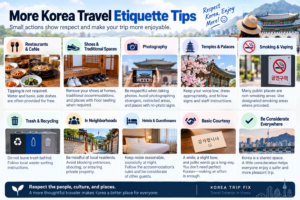
Do You Need to Tip in Korea?
Generally, no.
VISITKOREA states that tipping is not required or expected at Korean restaurants.
This is different from countries where restaurant staff depend heavily on tips.
You normally pay the amount shown on the bill.
There is usually no need to calculate an additional percentage for the server.
Official Korean food guidance also notes that basic requests such as additional water or common side dishes generally do not involve an extra service charge.
Should You Tip Taxi Drivers?
Routine taxi tipping is also not generally expected.
Pay the fare shown by the meter or the amount displayed through the taxi booking service.
You do not normally need to add a percentage-based tip.
Restaurant Etiquette in Korea
Korean restaurants vary widely, from traditional restaurants with floor seating to modern cafés and self-service restaurants.
Useful habits include:
- Wait to be seated if staff direct you
- Check whether water and side dishes are self-service
- Use the call button if one is provided
- Return trays where instructed at self-service restaurants
- Keep shared dining areas reasonably tidy
Some restaurants have utensils inside a drawer built into the table, while others provide them at the counter.
Follow the system used by that restaurant rather than assuming every restaurant works the same way.
Are Side Dishes Free?
At many Korean restaurants, basic side dishes known as banchan are included with the meal.
VISITKOREA notes that requests for additional basic side dishes do not generally involve extra charges.
However, this should not be interpreted as unlimited access to every item on the menu.
Special dishes, premium items, or additional main courses can still cost extra.
Is Water Free at Restaurants?
Drinking water is commonly provided without a separate charge at many Korean restaurants.
Some restaurants bring water to the table, while others have self-service water dispensers.
Follow the restaurant’s setup.
Should You Remove Your Shoes?
Sometimes.
You usually remove shoes before entering a private Korean home.
Some traditional accommodations, restaurants with floor seating, temples, and spaces using traditional heated floors may also require shoes to be removed.
VISITKOREA specifically advises that shoes are often removed when entering homes and spaces with traditional floor-style rooms.
A simple rule is to look for:
- A shoe rack near the entrance
- Other people’s shoes lined up outside
- A raised floor area
- A sign asking guests to remove shoes
If you see these signs, remove your shoes before stepping onto the raised floor.
What About Shoes in Hotels?
Most modern hotels do not require guests to remove shoes before entering the room.
However, Korean-style guesthouses, hanok accommodations, and rooms with traditional floor arrangements may have different expectations.
Follow the property’s instructions.
How Should You Behave in Korean Cafés?
Korean cafés are often used for meeting friends, studying, working, and relaxing.
Normal conversation is expected, but avoid excessively loud calls or videos.
If a café asks customers to return trays, separate waste, or use a designated pickup area, follow the signs.
During busy periods, avoid occupying significantly more seating than you need with bags or luggage.
Is It Okay to Leave Your Belongings at a Café Table?
You may see people temporarily leaving bags or personal items at their seats.
However, travelers should not interpret this as a guarantee that valuables are safe.
Keep passports, wallets, phones, and other important items with you whenever possible.
Photography Etiquette in Korea
Korea is very photography-friendly, but that does not mean every person or location can be photographed freely.
Be especially careful when photographing:
- Strangers at close range
- Children
- People inside private businesses
- Religious ceremonies
- Military or restricted areas
- Locations displaying no-photography signs
When a person is clearly the main subject of your photo, asking permission is the safer and more respectful approach.
Can You Take Photos Inside Palaces and Temples?
Photography rules depend on the specific location and space.
Outdoor photography may be widely allowed, while certain indoor exhibits, religious areas, performances, or ceremonies may have restrictions.
Follow signs and staff instructions rather than assuming one rule applies everywhere.
Temple Etiquette in Korea
Buddhist temples are both tourist attractions and active religious spaces.
Keep your voice low near worship areas and avoid interrupting people who are praying.
VISITKOREA travel guidance recommends avoiding overly revealing clothing when visiting Buddhist temples.
You should also follow signs concerning:
- Shoes
- Photography
- Restricted areas
- Food and drink
You do not need to copy religious rituals unless you genuinely wish to participate and understand what you are doing.
Palace Etiquette
Korea’s royal palaces are popular photography locations, especially for visitors wearing hanbok.
Visitors should still respect barriers, restricted buildings, gardens, and restoration areas.
Do not climb onto historic structures or cross ropes simply to get a better photograph.
If a ceremony or performance is taking place, follow staff instructions and keep designated paths clear.
What About Hanbok?
Visitors are welcome to rent and wear hanbok around many Korean palace districts.
VISITKOREA notes that hanbok rental shops are common near royal palaces and major tourist attractions.
Wearing hanbok is not considered disrespectful simply because you are a foreign visitor.
Handle rented clothing carefully and follow the rental shop’s return instructions.
Smoking Etiquette in Korea
Do not assume that smoking is allowed simply because you are outdoors.
Many public transportation areas, streets, parks, buildings, restaurants, and other locations have smoking restrictions.
Official tourism guidance notes that transportation facilities, major streets, parks, and some restaurants and bars may be designated non-smoking areas.
Use designated smoking areas where provided and follow local signs.
What About Vaping?
Do not assume electronic cigarettes can be used anywhere cigarettes are prohibited.
Follow posted smoking rules and use designated areas when required.
Trash Etiquette in Korea
Travelers sometimes notice that public trash bins are less obvious than expected in some areas.
Do not leave rubbish on benches, streets, subway platforms, or building entrances just because you cannot immediately find a bin.
Keep small trash with you until you find an appropriate disposal point.
Inside cafés, food courts, and convenience stores, follow signs showing where cups, food waste, recyclables, and general waste should go.
Convenience Store Etiquette
Many convenience stores have tables or small eating areas.
If you eat inside the store:
- Use the designated seating area
- Clean up after yourself
- Follow waste-sorting instructions
- Do not block merchandise aisles with luggage
Services vary by store, so do not assume every convenience store has seating, a restroom, or the same facilities.
Escalator Etiquette
Local habits about standing and walking on escalators can vary and safety campaigns may change over time.
The safest approach is to follow posted instructions and avoid blocking people unnecessarily.
Keep luggage stable and hold the handrail where appropriate.
Elevator Etiquette
Allow people to exit before entering.
Give priority to passengers who need additional space, such as wheelchair users, older passengers, people with strollers, and travelers with mobility difficulties.
Large suitcases should be positioned so they do not block the door.
Noise in Hotels and Guesthouses
Korea has many apartments, guesthouses, and hotels located close to residential buildings.
Keep noise reasonable, especially late at night and early in the morning.
Avoid loud conversations in hallways, slamming doors, or playing music loudly inside accommodation.
This is especially important at smaller guesthouses where rooms may be close together.
Etiquette in Residential Neighborhoods
Some popular cafés, hanok villages, markets, and photo spots are located in real residential neighborhoods.
Remember that local residents may be living just a few meters from popular tourist streets.
Avoid:
- Entering private property
- Blocking residential entrances
- Taking close-up photos through windows
- Shouting late at night
- Leaving trash behind
A beautiful alley may still be someone’s home.
Should You Bow in Korea?
A small nod or slight bow is commonly used as a polite greeting or gesture of thanks.
Tourists do not need to perform a formal deep bow in everyday situations.
A smile, slight nod, and polite phrase are usually enough.
Useful Polite Korean Words
| Korean | Meaning |
|---|---|
| 안녕하세요 | Hello |
| 감사합니다 | Thank you |
| 죄송합니다 | I’m sorry |
| 실례합니다 | Excuse me |
| 괜찮아요 | It’s okay |
You do not need perfect pronunciation. Making a polite effort is usually enough.
Should You Use Two Hands When Giving Something?
Using two hands, or supporting one hand with the other, can be a polite gesture when giving or receiving something from another person.
Travelers may notice this when exchanging items, business cards, gifts, or payments in more formal situations.
You do not need to worry about doing this perfectly during ordinary tourist transactions, but understanding the gesture can help you recognize Korean politeness customs.
Eating and Drinking on Public Transportation
Rules and expectations vary depending on the transportation service.
Even where eating is not explicitly prohibited, avoid foods that are messy, strongly scented, or likely to inconvenience other passengers.
Always follow posted rules on trains, buses, and stations.
What Should You Do If You Make a Mistake?
Do not panic.
Most minor etiquette mistakes made by travelers are easily resolved.
If someone points something out, simply stop what you are doing, apologize politely if needed, and follow the instruction.
A useful phrase is:
죄송합니다 (joesonghamnida)
I’m sorry.
Korea Travel Etiquette: Quick Checklist
On public transportation:
- Let people exit first
- Respect priority seating
- Keep noise low
- Keep luggage out of doorways and aisles
At restaurants and cafés:
- Do not worry about tipping
- Check whether water or side dishes are self-service
- Return trays when instructed
- Keep shared spaces tidy
At cultural and tourist sites:
- Follow photography rules
- Respect restricted areas
- Dress appropriately at religious sites
- Remove shoes when signs or the setting indicate that you should
In neighborhoods and accommodations:
- Keep nighttime noise reasonable
- Respect private property
- Dispose of trash properly
- Do not block doors or walkways
Final Thoughts
Korea travel etiquette is easier than it may initially seem.
You do not need to memorize every traditional Korean custom before your trip.
For most visitors, respecting shared spaces, following signs, keeping noise reasonable, understanding priority seating, and paying attention to local behavior will cover almost every everyday situation.
Remember that Korea is a modern country with many different types of restaurants, hotels, neighborhoods, and public spaces. Not every place follows exactly the same routine.
When you are unsure, look for posted instructions, observe what other people are doing, or politely ask a staff member. A little awareness can make your trip more comfortable for both you and the people around you.