

Buses are an important part of public transportation in Korea, especially when your destination is not directly connected to a subway station.
For first-time visitors, however, the process can feel unfamiliar. You need to know where to board, how to pay, when to press the stop button, and why tapping your transportation card again when getting off matters.
This guide explains how to use buses in Korea, including transportation cards, boarding and exiting, transfers, bus colors, route planning, and common mistakes travelers should avoid.
Are Buses in Korea Easy for Foreign Travelers to Use?
Once you understand the basic process, city buses are relatively straightforward.
The biggest challenges for visitors are usually:
- Finding the correct bus stop
- Checking the direction of travel
- Knowing when to get off
- Understanding transfer rules
- Recognizing different types of buses
Using a navigation app and a Korean transportation card makes the process much easier.
What Do You Need Before Taking a Bus?
The easiest option for most travelers is a rechargeable transportation card such as T-money.
Transportation cards can be used on buses and subways and can also provide transfer benefits when the applicable rules are followed.
You can buy and reload T-money at participating convenience stores and other authorized locations.
Read our
How to Buy a T-money Card in Korea guide
before your trip.
How to Find the Correct Bus
Do not rely only on the bus number.
Before boarding, confirm:
- The bus number
- The bus stop name
- The direction of travel
- Your destination stop
- The expected travel time

A single road may have bus stops for opposite directions located on different sides of the street.
Using Naver Map or another Korean navigation service is one of the easiest ways to confirm the correct stop and route.
See our
How to Use Naver Map in Korea guide
.
How to Board a City Bus in Korea
For many city buses, passengers normally board through the front door.
The basic process is:
- Wait at the correct bus stop.
- Check the bus number as it approaches.
- Board through the designated entrance.
- Tap your transportation card on the card reader.
- Wait for the reader to confirm the payment.
- Move inside the bus so other passengers can board.

If the card reader shows an error, try again or ask the driver for assistance.
Where Do You Tap Your Transportation Card?
There is normally a transportation-card reader near the entrance of a city bus.
Tap the card once when boarding.
You should also tap again on the reader near the exit when getting off.
The second tap is especially important when using a transfer-based fare system.
Why Should You Tap Again When Getting Off?
In Seoul, tapping when you leave the bus is necessary for the integrated transfer fare system to calculate your trip correctly.
If you plan to transfer to another bus or the subway, forgetting to tap when getting off may prevent the transfer discount from being applied.
Even when you are not transferring, developing the habit of tapping when exiting is the safest approach.
How Do You Request Your Stop?
Before the bus reaches your destination, press one of the stop buttons located throughout the bus.
The button tells the driver that someone wants to get off at the next stop.
Do not wait until the bus has already reached the stop.
When your destination is approaching:
- Check the next-stop display or navigation app.
- Press the stop button.
- Move toward the exit when it is safe.
- Tap your transportation card before leaving.
- Exit through the designated door.
How Do You Know When to Get Off?
Many buses display or announce upcoming stops.
However, relying on your navigation app as a backup is helpful, particularly when stop names are unfamiliar.
Keep your phone accessible and watch the route as you travel.
A useful strategy is to start paying close attention when you are two or three stops away from your destination.
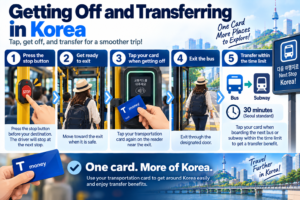
How Do Bus Transfers Work in Seoul?
Seoul operates an integrated public transportation fare system.
When using an eligible transportation card, transfers between buses and subways can receive a fare benefit when the transfer conditions are met.
According to current Seoul guidance, passengers should:
- Tap their card when boarding
- Tap again when getting off
- Transfer within the applicable time limit
- Avoid re-boarding the same bus route if expecting a transfer benefit
In Seoul, the standard transfer window is generally 30 minutes after getting off, with a longer window during designated nighttime hours.
Transfer rules vary by city, so do not assume Seoul’s rules apply everywhere in Korea.
Can You Transfer From a Bus to the Subway?
Yes, eligible transportation-card users can receive integrated transfer benefits between buses and subways in Seoul when they follow the transfer rules.
This is one reason transportation cards are more convenient than paying for each ride separately.
Can You Pay Cash on a Bus?
Payment rules vary depending on the city and bus system.
Even where cash payment is possible, transportation cards are generally more convenient for travelers because they simplify payment and allow applicable transfer benefits.
Do not assume that cash will provide the same transfer benefit as a transportation card.
Can You Use a Foreign Credit Card Directly on the Bus?
Do not assume that a foreign-issued credit card can be tapped directly on a Korean city bus.
Current Korea Tourism Organization transportation guidance recommends using a regular Korean transportation card such as T-money for ordinary bus card readers.
This is different from shops and restaurants, where international credit cards are much more widely accepted.
For general payment information, read our
How to Pay in Korea guide
.
What Do the Different Bus Colors in Seoul Mean?
Seoul uses colors to help identify different types of city buses.
Blue Buses
Blue buses generally operate longer trunk routes connecting major areas of Seoul.
Green Buses
Green buses generally serve shorter branch routes and connect neighborhoods with subway stations and other transportation hubs.
Red Buses
Red buses are generally metropolitan or rapid routes connecting Seoul with surrounding areas in the greater capital region.
Village Buses
Village buses operate shorter neighborhood routes, often serving residential areas that larger buses or subway lines do not reach directly.
Bus systems outside Seoul use their own colors and classifications, so do not apply Seoul’s color system to every city in Korea.
What Are Night Buses in Seoul?
Seoul also operates designated late-night bus routes.
These routes are useful when normal subway service has ended.
Operating routes and schedules can change, so check current information before relying on a night bus.
Can You Take a Bus With Luggage?
Small personal luggage is generally easier to manage on ordinary city buses than large suitcases.
City buses can become crowded, and they are not designed primarily for travelers carrying large luggage.
If you have a large suitcase, an airport limousine bus, train, taxi, or another luggage-friendly transportation option may be more comfortable.
Do not block aisles or doors with luggage.
Should You Use a City Bus From Incheon Airport?
Travelers arriving at Incheon International Airport normally have several transportation options, including airport buses, AREX trains, and taxis.
Airport limousine buses operate differently from ordinary Seoul city buses, so do not assume the same boarding or payment process applies.
Read our
Incheon Airport to Seoul guide
to compare the main options.
City Bus vs Express or Intercity Bus
It is important to distinguish local city buses from express and intercity buses.
| Bus Type | Main Purpose | Typical Use |
|---|---|---|
| City Bus | Local transportation | Travel within a city |
| Village Bus | Short neighborhood routes | Local residential areas |
| Express Bus | Long-distance travel | Travel between major cities |
| Intercity Bus | Regional travel | Travel between cities and towns |
Express and intercity buses usually involve a ticket or reservation system rather than simply tapping a city transportation card when boarding.
Can Foreign Travelers Book Express and Intercity Buses?
Yes, international-friendly booking options have improved.
In 2026, the Korea Tourism Organization highlighted foreigner-accessible booking services for express and intercity buses with multilingual support and foreign-card payment options.
Because booking channels and supported routes can change, check current options before planning a regional bus trip.
What If You Board the Wrong Bus?
Do not panic.
Use your navigation app to check your current location and the next stops.
If necessary:
- Press the stop button.
- Get off at the next safe stop.
- Tap your card when leaving.
- Recalculate the route in your navigation app.
Avoid staying on the bus hoping it will eventually return to your destination.
What If You Miss Your Stop?
Press the stop button as soon as you realize the mistake and get off at the next available stop.
Then use your navigation app to determine whether walking, taking another bus, or using the subway is the easiest way back.
Bus Etiquette in Korea
Basic public transportation etiquette makes the trip more comfortable for everyone.
- Allow passengers to exit before moving into crowded areas
- Do not block the bus doors
- Keep large bags out of the aisle
- Use headphones for audio
- Give priority seats to passengers who need them
- Hold a rail or handle when standing
Buses may accelerate or stop suddenly, so remain seated when possible or hold onto a secure handrail.
Common Bus Mistakes Travelers Make in Korea
- Waiting at the correct bus number but on the wrong side of the road
- Boarding without checking the destination direction
- Forgetting to tap the transportation card when getting off
- Waiting too long to press the stop button
- Assuming a foreign credit card can be tapped directly
- Assuming transfer rules are identical in every Korean city
- Confusing city buses with express or intercity buses
- Relying only on the bus number without checking the route
Korea Bus Quick Checklist
Before boarding:
- Check the bus number
- Confirm the direction
- Confirm your destination stop
- Have your transportation card ready
When boarding:
- Use the correct entrance
- Tap your transportation card
- Move away from the door
Before getting off:
- Check the next stop
- Press the stop button
- Move toward the exit safely
- Tap your transportation card again
When transferring:
- Make sure you tapped when exiting
- Check the local transfer time limit
- Confirm your next bus or subway route
Final Thoughts
Learning how to use buses in Korea becomes much easier once you understand the basic routine.
Find the correct stop, confirm the direction, tap your transportation card when boarding, press the stop button before your destination, and tap again when getting off.
Using Naver Map or another reliable navigation app can make bus travel significantly easier because you can follow your route and monitor upcoming stops.
Remember that Seoul’s transfer rules and bus classifications do not necessarily apply to every Korean city.
Check local information when traveling outside Seoul, and use a transportation card whenever possible for a smoother public transportation experience.