

Traveling in Korea with a food allergy requires more preparation than simply avoiding a few dishes.
Ingredients may be used in broths, sauces, marinades, side dishes, fried foods, and seasonings even when they are not obvious from looking at the finished meal.
Korea does have official food-allergen labeling rules, which can be very useful when buying packaged food. However, travelers should not assume that every restaurant menu will display complete allergen information.
This guide explains Food Allergies in Korea for international travelers, including official allergen labels, restaurant communication, cross-contact, useful Korean phrases, packaged food, and what to do in a serious emergency.
Important: This is a travel guide, not medical advice. If you have a diagnosed food allergy, follow the emergency plan and medication instructions given by your healthcare professional.
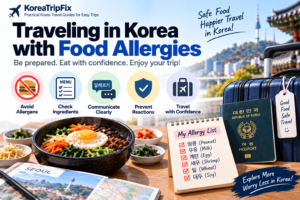
Quick Answer: Can You Travel in Korea With Food Allergies?
Yes, but travelers with serious food allergies should prepare before the trip and communicate their restrictions clearly.
A practical approach is to:
- Know the Korean name of your allergen.
- Carry a written allergy card in Korean.
- Check packaged-food labels carefully.
- Ask about sauces, broths, seasonings, and shared cooking equipment.
- Avoid guessing based only on how a dish looks.
- Carry any prescribed emergency medication as directed by your healthcare professional.
- Know that 119 is the emergency number for ambulance and medical emergencies in Korea.
If you are still learning how Korean restaurants generally work, read our How to Order Food in Korean Restaurants guide first. This article focuses specifically on allergy safety rather than the general ordering process.
Prepare Before You Travel to Korea
If your allergy can cause a serious reaction, do not wait until your first restaurant meal to think about communication.
Before traveling, prepare:
- The exact English name of your allergen
- The Korean name of your allergen
- A short written allergy explanation in Korean
- A list of related ingredients you also need to avoid
- Any medication prescribed for your allergy
- Your travel insurance information
- Emergency contact information
If you are traveling with prescription medication or an emergency device, follow the transportation and storage instructions provided by your clinician, manufacturer, airline, and relevant authorities.
Travelers who want to check medical coverage before departure can also read our Korea Travel Insurance Guide.
How Food Allergen Labels Work in Korea
Korea’s Ministry of Food and Drug Safety, or MFDS, has an official allergen-labeling system for food products.
According to the MFDS Food Labeling System, foods containing designated allergenic ingredients must identify those allergens according to Korea’s labeling rules.
MFDS explains that when a designated allergen is used as an ingredient, allergen information should be displayed separately near the ingredient information so consumers can recognize it more easily.
A label may use wording equivalent to:
This product contains wheat and milk.
However, most products sold for the domestic Korean market may contain important label information in Korean. A translation app can help, but travelers with serious allergies should not rely on machine translation alone when the meaning is unclear.
Which Allergens Are Included in Korea’s Official List?
The current MFDS allergen-labeling information lists the following 19 categories:
- Eggs from poultry
- Milk
- Buckwheat
- Peanuts
- Soybeans
- Wheat
- Mackerel
- Crab
- Shrimp
- Pork
- Peach
- Tomato
- Sulfites when added and present at the specified level
- Walnuts
- Chicken
- Beef
- Squid
- Shellfish, including oysters, abalone, and mussels
- Pine nuts
You can check the latest official list directly on the MFDS website.
Korean Names for Common Allergens
| English | Korean |
|---|---|
| Egg | 계란 / 알류 |
| Milk | 우유 |
| Peanut | 땅콩 |
| Soy / Soybean | 대두 / 콩 |
| Wheat | 밀 |
| Buckwheat | 메밀 |
| Walnut | 호두 |
| Pine nut | 잣 |
| Shrimp | 새우 |
| Crab | 게 |
| Mackerel | 고등어 |
| Squid | 오징어 |
| Shellfish | 조개류 |
| Pork | 돼지고기 |
| Beef | 쇠고기 / 소고기 |
| Chicken | 닭고기 |
| Peach | 복숭아 |
| Tomato | 토마토 |
| Sulfites | 아황산류 |
The Official Allergen List Does Not Cover Every Possible Allergy
This is extremely important.
Korea’s mandatory allergen list should not be interpreted as a complete list of every food that can cause an allergic reaction.
For example, sesame is not included in the MFDS list shown above.
If you have a sesame allergy, the absence of a separate allergen warning does not prove that a product is safe.
Sesame can appear in Korean food as:
- Sesame seeds — 깨 / 참깨
- Sesame oil — 참기름
- Seasonings and sauces
- Garnishes
Similarly, Korea’s official list specifically identifies walnuts and pine nuts rather than treating every tree nut as one single allergen category.
If your allergy is not one of the specifically listed allergens, read the full ingredient list and communicate your allergy directly.
Do Korean Restaurants Have to Show Allergens on Every Menu?
No. Travelers should not expect every Korean restaurant to provide a complete allergen chart for every dish.
Korea has specific allergen-display requirements for certain qualifying businesses and foods, including designated businesses selling children’s favorite foods such as hamburgers, pizza, baked goods, and ice cream.
The Korean government’s Easy Law Information Service explains these specific restaurant allergen-display rules.
These requirements should not be treated as a universal rule covering every independent restaurant and every Korean dish.
If you have a serious allergy, ask directly even when no allergen information appears on the menu.
Do Not Rely Only on an English Menu
An English menu is useful for understanding dish names and prices, but it may not include every ingredient.
A translated menu might simply say:
Beef soup
That does not necessarily tell you every ingredient used in:
- The broth
- The sauce
- The garnish
- The seasoning
- The side dishes
When allergy safety matters, ask about the ingredient rather than relying on the dish name.
How to Tell Restaurant Staff About a Food Allergy
A simple general phrase is:
저는 음식 알레르기가 있어요.
Jeoneun eumsik allereugiga isseoyo.
I have a food allergy.
It is much more useful to name the specific allergen.
For example:
저는 땅콩 알레르기가 있어요.
Jeoneun ttangkong allereugiga isseoyo.
I have a peanut allergy.
If your allergy is serious, you can say:
심한 알레르기가 있어요.
Simhan allereugiga isseoyo.
I have a severe allergy.
How to Ask If a Dish Contains Your Allergen
For peanuts:
땅콩이 들어 있나요?
Ttangkongi deureo innayo?
Does this contain peanuts?
For milk:
우유가 들어 있나요?
Uyuga deureo innayo?
Does this contain milk?
For shrimp:
새우가 들어 있나요?
Saeuga deureo innayo?
Does this contain shrimp?
Adapt the phrase to your own allergen.
How to Explain That Even a Small Amount Is a Problem
For a severe allergy, it may help to make clear that simply removing the visible ingredient is not enough.
You can say:
조금만 들어가도 안 돼요.
Jogeumman deureogado an dwaeyo.
Even a small amount is not okay.
This is useful when you need staff to understand that the allergy is different from simply disliking an ingredient.
Prepare a Korean Allergy Card
A written message is often easier than trying to explain a serious allergy verbally in a busy restaurant.
You can save a message on your phone such as:
저는 땅콩 알레르기가 심합니다. 땅콩이나 땅콩이 들어간 소스, 조미료를 먹을 수 없습니다. 같은 조리도구나 기름을 사용했는지도 확인해 주세요.
Meaning:
I have a severe peanut allergy. I cannot eat peanuts or sauces and seasonings containing peanuts. Please also check whether the same cooking utensils or oil are used.
Replace peanut with your actual allergen and have the message reviewed by a fluent Korean speaker if your allergy is severe.
Ask About Cross-Contact
For some travelers, checking the ingredient list is not enough.
Cross-contact can occur when foods share:
- Cooking oil
- Grills
- Knives
- Cutting boards
- Tongs
- Pots
- Preparation surfaces
A useful question is:
같은 조리도구나 기름을 사용하나요?
Gateun joridogu-na gireumeul sayonghanayo?
Do you use the same cooking utensils or oil?
If restaurant staff cannot confidently explain the ingredients or preparation method, choosing another restaurant or dish may be the safer option.
Common Korean Food Situations to Check Carefully
There is no list of Korean foods that is automatically unsafe for everyone with an allergy.
Recipes differ by restaurant, brand, and household.
However, several preparation methods deserve extra attention.
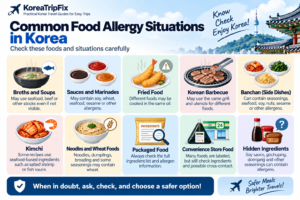
Broths and Soups
A soup that does not visibly contain seafood or meat may still use an anchovy, shellfish, beef, or other stock.
Ask what the broth is made from rather than judging only the visible ingredients.
Sauces and Marinades
Soy, wheat, seafood ingredients, sesame, or other allergens may be present in sauces and seasonings depending on the recipe.
Removing a topping does not remove ingredients already mixed into a sauce.
Fried Food
Different foods may be cooked in the same fryer.
If shared oil matters for your allergy, ask before ordering.
Korean Barbecue
Several foods may be cooked on the same grill or handled with the same utensils.
This can matter if you need to avoid cross-contact.
Banchan
Banchan are the small side dishes served with many Korean meals.
Do not assume that vegetable-based banchan contain only vegetables.
Seasonings, sauces, seafood ingredients, soy products, nuts, or sesame can be used depending on the dish.
Kimchi
Kimchi recipes vary.
Some versions use seafood-based ingredients such as salted shrimp or fish sauce, while others do not.
If seafood is your allergen, ask rather than assuming all kimchi is prepared the same way.
What About Soy Sauce, Gochujang, and Doenjang?
These Korean seasonings are common, but ingredients can differ by product.
Soy sauce commonly involves soy and may also involve wheat depending on the product.
Doenjang is a fermented soybean paste, so travelers with soy allergies should treat it carefully.
Gochujang ingredients vary by brand and recipe and may contain ingredients relevant to certain allergies.
Do not rely only on the English name of a sauce. Check the actual product or ask the restaurant about ingredients.
What If You Have a Wheat Allergy or Celiac Disease?
Korea’s allergen-labeling system includes wheat.
However, wheat allergy and celiac disease are not the same condition.
A wheat allergen warning can be useful, but travelers who require a strict gluten-free diet should still check the entire ingredient list and cross-contact risk.
Noodles, breading, dumpling wrappers, sauces, processed foods, and some seasonings may contain wheat.
Do not assume that a rice-based Korean dish is automatically gluten-free.
Food Allergy vs Vegetarian or Vegan Diet
A food allergy and a dietary preference are not the same thing.
A vegetarian restaurant may still use an ingredient that causes your allergy.
A vegan product can still contain allergens such as:
- Peanuts
- Tree nuts
- Soy
- Wheat
- Sesame
If you also follow a vegetarian or vegan diet, see our Vegetarian and Vegan Food in Korea guide, but continue treating your allergy as a separate safety issue.
How to Check Packaged Food in Korea
Packaged food can sometimes be easier to evaluate than restaurant food because there is a physical ingredient label.
Before buying, check:
- The full ingredient list
- The separate allergen statement
- Any warning about shared production equipment or possible allergen mixture
- Imported-product Korean label stickers
Use the MFDS allergen list as a starting point, not as proof that every possible personal allergen will be highlighted.
If you are unsure what a label says, do not guess.
Can Convenience Stores Be Easier for Travelers With Allergies?
Convenience stores can be useful because many foods are individually packaged and labeled.
That does not mean every product is automatically easier or safer.
Instant meals, sandwiches, gimbap, desserts, snacks, sauces, and ready-to-eat foods can contain multiple allergens.
Always check the specific product.
For general store information, see our How to Use Convenience Stores in Korea guide.
Should You Use a Translation App?
Yes, as a supporting tool.
A camera translation feature can help you understand:
- Ingredient lists
- Allergen warnings
- Menus
- Restaurant signs
But machine translation can misunderstand food terminology.
For a potentially life-threatening allergy, a prepared Korean allergy card is more reliable than creating a complicated explanation from scratch every time you eat.
What If Staff Say They Are Not Sure?
Take uncertainty seriously.
Restaurant staff may not know every ingredient in a pre-made sauce, broth, seasoning mix, or packaged component.
If they cannot confirm whether your allergen is present, do not pressure them to say that the food is safe.
Choose another dish or another restaurant where the ingredients can be confirmed more clearly.
What to Do During a Serious Allergic Reaction in Korea
If you develop a severe or rapidly worsening allergic reaction, follow your prescribed emergency plan and seek emergency medical help immediately.
For an ambulance or medical emergency in Korea, call 119.
Korea’s official government information states that the 119 emergency service operates 24 hours a day, year-round and is available to foreign nationals traveling in Korea.
Korea.net – Emergency Medical Services in Korea
VISITKOREA also lists 119 for medical emergencies.
VISITKOREA – Emergency Situations
For more emergency contact information, see our Emergency Numbers in Korea guide.
Is 1330 an Emergency Number?
No.
The 1330 Korea Travel Helpline provides tourism information and multilingual travel assistance.
It can be useful when you need travel information or interpretation assistance in a non-emergency situation.
However, do not delay calling 119 during a medical emergency because you are trying to reach a tourist hotline first.
You can check the current service information on the official 1330 Korea Travel Helpline page.
Keep Records After Medical Treatment
If you receive medical treatment during your trip, keep any documents you receive.
These may include:
- Medical bills
- Receipts
- Prescription records
- Medical reports
- Insurance-related documents
Your insurer may require specific documents when you make a claim.
Check your insurance company’s instructions rather than assuming that every insurer requires the same paperwork.
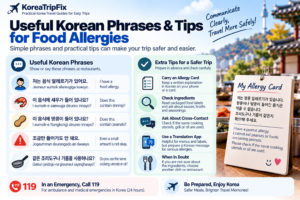
Useful Korean Food Allergy Phrases
| English | Korean |
|---|---|
| I have a food allergy. | 저는 음식 알레르기가 있어요. |
| I have a severe allergy. | 심한 알레르기가 있어요. |
| Does this contain peanuts? | 땅콩이 들어 있나요? |
| Does this contain milk? | 우유가 들어 있나요? |
| Does this contain eggs? | 계란이 들어 있나요? |
| Does this contain shrimp? | 새우가 들어 있나요? |
| Even a small amount is not okay. | 조금만 들어가도 안 돼요. |
| Do you use the same cooking utensils or oil? | 같은 조리도구나 기름을 사용하나요? |
| Please call 119. | 119 불러 주세요. |
Common Mistakes Travelers With Food Allergies Make
Assuming a Dish Is Safe Because the Allergen Is Not Visible
Broths, sauces, marinades, and seasonings can contain ingredients that are not visible on the plate.
Assuming Every Restaurant Displays Allergens
Korea has allergen-labeling rules, but there is no universal menu-level allergen chart covering every dish at every restaurant.
Using Only the Word “Allergy”
Tell staff the exact ingredient you cannot eat.
Forgetting About Cross-Contact
If shared utensils, grills, or oil are important for your allergy, ask specifically.
Assuming Vegan Means Allergy-Safe
Vegan food may still contain soy, wheat, peanuts, tree nuts, sesame, or other allergens.
Trusting Translation Apps Without Checking
Translation tools are useful, but unclear translations should not be treated as confirmation that a food is safe.
Waiting to Prepare Until You Arrive
Create your Korean allergy message and emergency plan before your flight.
Quick Food Allergy Checklist for Korea
- Write down your allergen in Korean.
- Prepare a Korean allergy card.
- Bring prescribed medication according to your medical plan.
- Save 119 as Korea’s medical emergency number.
- Check the MFDS allergen-labeling information.
- Read full packaged-food ingredient labels.
- Do not assume every allergen will have a separate warning.
- Ask about broths, sauces, marinades, and seasonings.
- Ask about shared oil and cooking equipment if cross-contact matters.
- Do not assume vegan or vegetarian food is allergy-safe.
- Choose another food if ingredients cannot be confirmed.
- Keep medical and insurance documents if treatment is required.
Final Thoughts
Managing Food Allergies in Korea is much easier when you prepare your communication before the trip.
Korea’s official allergen-labeling system can help with packaged foods, but it should not replace direct communication in restaurants.
Know the Korean name of your allergen, carry a written allergy message, ask about hidden ingredients and cross-contact, and never assume that a dish is safe simply because an allergen is not visible.
If you experience a serious allergic reaction, follow your prescribed emergency plan and call 119 for emergency medical assistance.
Food-labeling rules, restaurant practices, and service information can change, so check the latest official MFDS and Korean government information before your trip.