
Getting sick while traveling can be stressful, especially when you do not speak the local language or understand how pharmacies work.
Fortunately, pharmacies are common in Korean cities, and pharmacists can often help travelers with basic over-the-counter medicine questions and medication instructions.
This guide explains how to use pharmacies in Korea, how to find one, what information to show the pharmacist, how prescriptions work, and what to do when you need medical help instead of a pharmacy.
How Do Pharmacies Work in Korea?
Pharmacies in Korea are usually marked with the Korean word 약국, which means pharmacy.
Pharmacists dispense prescription medicine and also sell over-the-counter medicines and other health-related products.
For prescription medicines, Korea generally follows a separation-of-prescribing-and-dispensing system: a doctor provides the prescription and a pharmacist dispenses the medicine.
This means that if you need a medicine that requires a prescription, you will normally need to visit a medical clinic or hospital first.

How to Find a Pharmacy in Korea
You can find pharmacies throughout major cities, especially near:
- Hospitals and clinics
- Subway stations
- Busy shopping streets
- Residential neighborhoods
- Major tourist districts
- Transportation hubs
Look for the sign 약국.
You can also search your map app using:
- Pharmacy
- 약국
If you use Naver Map, searching in Korean may return more local results.
See our
How to Use Naver Map in Korea guide
for navigation tips.
Are Pharmacies Open Late at Night?
Pharmacy opening hours vary significantly.
Some pharmacies close in the evening, while others operate later or provide service on weekends.
Korea also operates public late-night pharmacy programs in some areas, but availability differs by city and district.
Do not assume that a nearby pharmacy shown on a map is currently open.
Always check the latest opening hours before traveling to the location.
How to Ask for Medicine if You Do Not Speak Korean
The Korea Tourism Organization recommends using a translation app if you are not comfortable explaining your symptoms in Korean.
You can tell the pharmacist:
- Where you feel discomfort
- What symptoms you have
- How long the symptoms have lasted
- Whether you have any allergies
- What medicines you already take
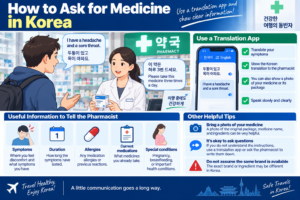
If communication is difficult, showing a photo of a medicine or its packaging may also help the pharmacist understand what you are asking about.
However, do not assume that the same brand or exact ingredient will be available in Korea.
What Information Should You Tell the Pharmacist?
Before buying or taking medicine, tell the pharmacist about important information that may affect your medication choice.
This may include:
- Medication allergies
- Other medicines you are currently taking
- Previous reactions to medicines
- Pregnancy or breastfeeding, if relevant
- Important health conditions
If you already have a medication list from home, keeping a photo or digital copy on your phone can be useful.
Should You Bring a Photo of Your Medicine?
Yes, it can be helpful.
Official tourism guidance specifically suggests showing a photo of the medicine if language communication is difficult.
For better results, try to show:
- The original package
- The medicine name
- The active ingredient
- The dosage listed on the label
This gives the pharmacist more information than simply describing the color or shape of a tablet.
Can You Buy Medicine Without a Prescription?
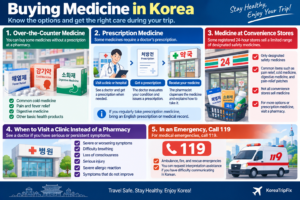
Some medicines in Korea can be purchased from a pharmacy without a prescription.
Other medicines require a doctor’s prescription.
The exact category depends on the medicine, so do not assume that something sold without a prescription in your home country will also be available without a prescription in Korea.
Ask the pharmacist if you are unsure.
What If You Need Prescription Medicine?
If the medicine you need requires a prescription, you will normally need to visit a clinic or hospital before going to the pharmacy.
The doctor can evaluate your condition and issue a prescription when appropriate.
The pharmacist then dispenses the prescribed medicine and explains how it should be taken.
If you regularly take a prescription medicine, bring documentation from your home country whenever possible.
The Korea Tourism Organization recommends carrying medical records or an English prescription for travelers who may need more complex or prescription medication.
Should You Bring an English Prescription?
If you have an ongoing medical condition or regularly take prescription medication, carrying an English-language prescription or medical record can make communication easier.
It is also useful to keep a digital photo or copy in case the original document is lost.
Keep in mind that a foreign prescription does not automatically guarantee that a Korean pharmacy can dispense the same medicine.
A local medical evaluation may still be required.
Can You Buy Medicine at Convenience Stores?
Some registered 24-hour stores in Korea are allowed to sell a limited range of designated emergency household medicines.
The system includes certain categories such as pain or fever relief, cold medicine, digestive medicine, and pain-relief patches.
However, this is a limited list and does not mean that a convenience store functions like a pharmacy.
If you need medication advice, a wider selection, or a prescription medicine, visit a pharmacy instead.
Do All Convenience Stores Sell Medicine?
No.
Only stores that meet the legal requirements and are registered to sell designated safety medicines may sell them.
Availability can also differ between stores.
Do not rely on a convenience store for medicine you consider essential to your trip.
For general convenience store information, see our
How to Use Convenience Stores in Korea guide
.
Can a Pharmacist Recommend Medicine?
A pharmacist can help explain available over-the-counter products and how they are used.
Describe your symptoms and relevant medical information as accurately as possible.
However, some symptoms require medical evaluation rather than self-treatment.
If your symptoms are severe, unusual, worsening, or persistent, consider visiting a medical clinic instead of repeatedly trying different medicines.
How Do You Understand the Medication Instructions?
Before leaving the pharmacy, make sure you understand:
- How much medicine to take
- How often to take it
- Whether to take it before or after food
- How long to use it
- Important warnings or precautions
If you do not understand the instructions, use a translation app or ask the pharmacist to write them down.
Do not guess the dosage based only on the appearance of the medicine.
Can You Pay With a Foreign Credit Card?
Card acceptance varies by pharmacy.
Many businesses in Korea accept cards, but travelers should still carry an alternative payment method in case a particular card does not work.
For general payment information, read our
How to Pay in Korea guide
.
Are There Pharmacies at Korean Airports?
Major airports may have pharmacies or other places where travelers can purchase basic health-related products.
The Korea Tourism Organization’s pharmacy guide identifies pharmacy locations at major airports including Gimpo International Airport and Incheon International Airport.
Locations and operating hours can change, so check the airport’s current facility information before relying on an airport pharmacy.
What If You Need Medicine at Night or on a Holiday?
If a nearby pharmacy is closed, search for another pharmacy that is currently open or check whether your area has a public late-night pharmacy.
You may also find a limited range of designated safety medicines at registered 24-hour convenience stores.
For urgent medical problems, do not wait for a pharmacy to open.
Seek appropriate medical care instead.
When Should You Go to a Clinic Instead of a Pharmacy?
A pharmacy is useful for medication advice and minor health needs, but it is not a substitute for medical evaluation when you are seriously ill.
Consider seeking medical care if you have symptoms such as:
- Severe or rapidly worsening symptoms
- Difficulty breathing
- Loss of consciousness
- A serious injury
- A severe allergic reaction
- Persistent symptoms that are not improving
This is not a complete medical checklist. When you are unsure whether a condition is serious, seek professional medical care.
What If It Is an Emergency?
For a medical emergency in Korea, call 119.
119 handles ambulance, fire, and rescue emergencies.
If you have difficulty communicating in Korean, you can request interpretation assistance.
Read our
Emergency Numbers in Korea guide
and save the important numbers before your trip.
Useful Korean Pharmacy Words
| Korean | Meaning |
|---|---|
| 약국 | Pharmacy |
| 약 | Medicine |
| 처방전 | Prescription |
| 알레르기 | Allergy |
| 병원 | Hospital / medical facility |
You do not need to memorize these words, but saving them on your phone can be useful.
Pharmacies in Korea: Quick Checklist
Before visiting a pharmacy:
- Search for 약국 in your map app
- Check current opening hours
- Prepare a translation app
- Keep photos of your regular medicines
- Know your medication allergies
- Bring an English prescription or medical record if relevant
At the pharmacy:
- Explain your symptoms clearly
- Tell the pharmacist about other medicines you take
- Ask whether a prescription is required
- Confirm how and when to take the medicine
- Ask questions if the instructions are unclear
Final Thoughts
Using pharmacies in Korea is much easier when you prepare a few things before your trip.
Save the Korean word 약국, keep a translation app ready, and carry information about any medicines or allergies that may be important.
Remember that some medicines require a doctor’s prescription, and convenience stores only sell a limited range of designated safety medicines.
Most importantly, do not rely on a pharmacy when you need urgent medical treatment.
For a serious medical emergency, call 119 and seek immediate professional help.