

Your hotel is in Busan, but your flight lands at Incheon Airport. Before you start searching for trains, one question comes first:
Do you need to go into Seoul first, or can you continue directly toward Busan?
The answer is that most travelers heading from Incheon Airport to Busan will need to connect through another transportation point. The most common route is traveling from Incheon Airport to Seoul Station and then taking a KTX train to Busan. The airport and KTX services are separate systems, so planning the connection is an important part of the journey.
The right choice depends on your arrival time, luggage, and whether you want to reach Busan on the same day or stay near the airport or Seoul first.
Decide if you should travel to Busan on your arrival day
Landing time is not the same as departure time. After an international flight, you still need time for immigration, baggage collection, customs, walking through the terminal, and finding your transportation.
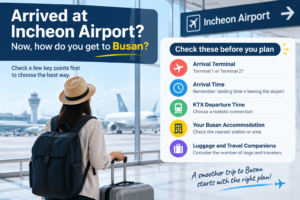
Before booking your connection, check these details:
- Your arrival terminal at Incheon Airport
- Your actual landing time and expected time to exit the airport
- Your KTX departure time and departure station
- The location of your Busan accommodation
- The amount of luggage and number of travelers
A morning arrival gives you more flexibility. A late afternoon or evening arrival requires more careful planning because missing the final connection can change your entire schedule.
How the Incheon Airport to Busan KTX route works
There is no KTX train that starts directly from Incheon Airport to Busan. Most travelers first move from the airport to a KTX departure station, then continue by high-speed rail.
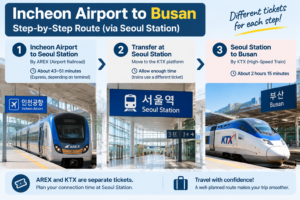
The common route is:
- Incheon Airport → Seoul Station by airport railroad or other transportation
- Seoul Station → Busan Station by KTX
The Airport Railroad (AREX) connects Incheon Airport with Seoul Station. The express service takes about 43 minutes from Terminal 1 and about 51 minutes from Terminal 2, while all-stop services take longer.
Remember that AREX and KTX are different trains. You need separate tickets and enough time to move inside Seoul Station between services.
Seoul Station is a transfer point, not a requirement to visit Seoul. You do not need to stay in Seoul or plan sightseeing there unless it fits your travel schedule.
For detailed KTX ticket booking steps, see our KTX ticket guide.
How to plan KTX tickets after an international flight
Booking a KTX seat in advance can be useful during busy travel periods because popular trains may have limited availability. KORAIL provides an official English booking service for foreign travelers.
However, booking too tightly after your flight arrival can create stress. A delayed flight, long immigration line, or slow baggage collection can cause you to miss your planned train.
When choosing your KTX departure time, leave room for unexpected delays rather than calculating only the airport arrival time.
If you miss your planned train, check the current KORAIL change, cancellation, and refund rules for your ticket type. Rules can vary depending on the ticket and timing.
Traveling with large luggage or family members
The fastest route is not always the easiest route.
Travelers with large suitcases should consider:
- Walking distance between airport areas and train platforms
- Moving luggage through Seoul Station
- Number of transfers required
- Energy levels after a long international flight
A solo traveler with a small bag may find the train connection simple. A family with children or several large suitcases may prefer a route with fewer transfers, even if it costs more or takes longer.
Choose based on your actual travel situation, not only the shortest travel time shown in a search result.
Should you consider a bus or flight instead?
Some travelers compare trains with buses or flights, but each option has different conditions.
For buses, check the exact departure point, destination terminal, operating schedule, and reservation method before relying on the route. Incheon Airport provides links for intercity and express bus reservations, but available routes and schedules should be checked before travel.
Flights require extra checking. An airport search result does not always mean the option is convenient for an arriving international passenger. Consider airport transfer time, check-in requirements, and whether your ticket can actually be used in your situation.
For many visitors, KTX remains the main option to compare because it connects directly to Busan Station after reaching the rail network.
What if your flight arrives late at night?
A late arrival changes the decision.
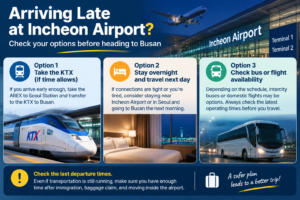
Even if transportation services are still operating, you need to consider whether the remaining connection is realistic after immigration, baggage collection, and movement inside the airport.
If reaching Busan on the same day feels uncertain, staying near your arrival area and traveling the next morning can be a practical alternative.
Do not choose a connection only because the timetable shows it exists. The important question is whether you can realistically reach the departure point in time.
Arriving in Busan does not always mean arriving at your hotel
Your final destination matters after reaching Busan.
Busan Station, Busan Central Bus Terminal, and Gimhae Airport are different locations. Your next step depends on where your accommodation is located.
For example, travelers staying near areas such as Seomyeon or Haeundae may still need additional transportation after arriving in Busan.
Use a navigation app to check the final connection before you leave the station. Our Naver Map guide can help with finding routes after arrival.
Choose your route based on your arrival situation
For most international visitors, the journey from Incheon Airport to Busan is not difficult because of distance alone. The challenge is connecting each step after landing.
Check your arrival time, choose a realistic connection, prepare for luggage, and keep a backup plan if your flight is delayed.
A successful arrival-day trip is not about finding the shortest route. It is about choosing a route that matches your actual travel conditions.