

Understanding trash and recycling in Korea can be surprisingly confusing for first-time visitors.
You may notice that public trash cans are not always easy to find, while homes and accommodations often separate waste into several different categories.
Travelers commonly wonder where to throw away coffee cups, food containers, plastic bottles, leftover food, and ordinary trash.
The basic rules are manageable once you understand one important point: waste disposal rules can vary by city, district, building, and accommodation.
This guide explains the practical basics travelers should know without assuming that every part of Korea uses exactly the same disposal system.
Why Can Trash Disposal Feel Confusing in Korea?
Korea separates many types of household waste for recycling and resource recovery.
Depending on where you are staying, you may see separate collection areas for:
- General waste
- Food waste
- Plastic
- Paper
- Glass bottles
- Metal cans
- Other recyclables
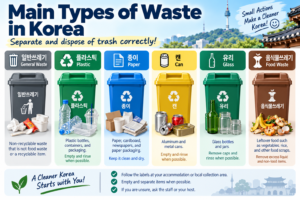
However, the exact categories, bags, collection points, and disposal times can vary locally.
This is why travelers staying in hotels, guesthouses, hostels, and short-term rentals should follow the instructions provided by the property.
Why Are Public Trash Cans Sometimes Hard to Find?
Travelers may notice that public trash cans are less common on some streets than they expect.
This does not mean that littering is acceptable.
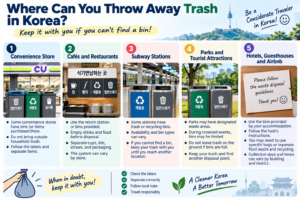
If you cannot find a bin, the simplest option is to keep your trash with you until you reach a place with an appropriate disposal point.
Subway stations, transportation facilities, parks, shopping areas, and large public facilities may have trash or recycling bins, but availability varies.
Can You Throw Trash Away at a Convenience Store?
Some convenience stores provide bins for waste generated from products purchased there.
However, you should not assume that every convenience store accepts outside household trash.
If bins are available, follow the labels and separate items as instructed.
For more information about convenience stores, see our
Convenience Stores in Korea guide
.
What Is General Waste?
General waste usually means household trash that is not accepted as recyclable or food waste.
Examples can include contaminated materials and other non-recyclable household items.
Residents commonly use designated volume-based waste bags, often called 종량제 봉투.
However, tourists staying in hotels normally do not need to buy these bags because the accommodation manages guest-room waste.
If you are staying in an apartment, guesthouse, or short-term rental, ask the host which bags and disposal area you should use.
What Are Volume-Based Waste Bags?
Korea uses a volume-based waste disposal system for general household waste in many areas.
Designated bags are purchased locally and used for ordinary trash.
These bags are not necessarily interchangeable between every city or district.
For short-term visitors, the most important rule is simple:
Do not buy random waste bags before checking the instructions for your accommodation.
What Counts as Recycling?
Common recyclable categories may include:
- Plastic bottles and containers
- Glass bottles
- Metal cans
- Paper and cardboard
The exact separation system varies by building and local government.
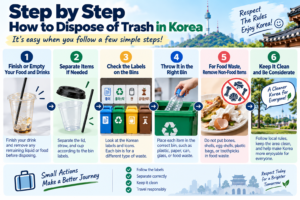
Look at the labels on the recycling bins rather than relying only on what you use at home.
Should You Rinse Recyclable Containers?
Yes, when practical.
Food and liquid residue can make recycling more difficult.
Empty containers, remove obvious contents, and follow the instructions at the collection point.
If a container is heavily contaminated and cannot be cleaned, the correct disposal category may differ.
What About Plastic Bottles?
Plastic beverage bottles are commonly collected for recycling.
Depending on the collection system, you may be asked to:
- Empty the bottle
- Remove remaining liquid
- Remove or separate labels
- Compress the bottle if requested
Always follow the instructions shown at your accommodation or recycling station.
What About Disposable Coffee Cups?
Disposable cups should not automatically be treated the same way everywhere.
A clean plastic or paper cup may be collected differently from a cup that still contains coffee, ice, milk, or other residue.
Before disposing of a drink cup:
- Finish or empty the drink.
- Remove any remaining liquid or ice.
- Separate the lid, straw, and cup if the bins instruct you to do so.
- Use the labeled disposal bins available at that location.
What About Takeaway Food Containers?
Food containers can be confusing because the material may technically be recyclable while food residue makes disposal more difficult.
Empty leftover food first.
If the container can be cleaned easily, rinse it before placing it in the appropriate recycling category.
If it is heavily contaminated, follow the local instructions rather than assuming it belongs in recycling.
What Is Food Waste in Korea?
Food waste is collected separately in many parts of Korea.
However, not everything left over from a meal counts as food waste.
Seoul’s official food-waste guidance specifically identifies several items that should not be placed in food-waste collection.
What Should Not Go Into Food Waste?
According to Seoul’s official food-waste separation guidance, examples of items that should not be disposed of as food waste include:
- Animal bones
- Fish bones
- Shellfish shells
- Crab and lobster shells
- Egg shells
- Hard fruit seeds
- Hard nut shells
- Tea grounds
- Plastic bags
- Bottle caps
- Wooden toothpicks
- Straws
- Plastic utensils
- Foil
In simple terms, hard or non-food materials that cannot be processed with ordinary food waste often need to be separated.
Should Food Waste Be Drained?
Yes.
Seoul’s official guidance recommends removing excess moisture and foreign materials before disposing of food waste.
This means you should avoid throwing large amounts of liquid into a food-waste container.
What About Kimchi and Other Salty Foods?
Seoul’s guidance recommends reducing salt from very salty foods such as kimchi before food-waste disposal.
However, travelers staying in short-term accommodation should first follow the property’s disposal instructions rather than trying to interpret municipal rules independently.
Do Hotels Separate Guest Trash?
Hotels generally manage their own waste disposal systems.
As a guest, use the trash and recycling bins provided in your room or elsewhere in the hotel.
If there are separate recycling bins, follow the labels.
You normally do not need to purchase municipal waste bags for a standard hotel stay.
What About Guesthouses and Hostels?
Guesthouses and hostels may provide shared recycling stations.
Look for signs near:
- Shared kitchens
- Entrances
- Utility rooms
- Outdoor collection areas
If you cannot understand the labels, ask the staff before leaving your trash.
What About Airbnb or Short-Term Apartments?
This is where disposal rules matter most.
Apartment-style accommodation may expect guests to follow the same waste separation system used by residents.
The host may provide instructions for:
- General waste bags
- Food-waste bags or containers
- Recycling areas
- Collection days
- Allowed disposal times
Do not leave bags outside the building at a random time.
Collection schedules can vary by district and neighborhood.
Are Trash Collection Days the Same Everywhere?
No.
Waste collection schedules can vary between cities and even between districts within the same city.
For example, Seoul publishes district-specific disposal schedules during major holidays because different districts may allow waste to be placed outside on different dates.
This shows why travelers staying in residential accommodation should follow local or host instructions rather than using a nationwide schedule.
Can You Leave Trash on the Street?
Do not leave ordinary trash on the street unless it is the designated collection point and you are following the local disposal rules.
Residential waste is normally placed out according to local rules, designated locations, and collection schedules.
For tourists, asking your accommodation is much easier than trying to determine the local system yourself.
What Should You Do With Trash While Sightseeing?
If there is no public bin nearby, keep the trash temporarily.
A small reusable bag can be useful for:
- Snack wrappers
- Tissues
- Receipts
- Empty drink containers
Dispose of them later when you find the correct bin.
Can You Leave Trash at a Café?
If you consume food or drinks at a café, use the return station or bins provided by that café.
Many cafés ask customers to return trays and separate:
- Leftover liquid
- Cups
- Lids
- Straws
- General trash
The exact system varies by store.
What About Fast-Food Restaurants?
Fast-food restaurants often have self-service waste stations.
Look at the icons and labels before throwing everything into one opening.
You may need to empty drinks and separate cups or other packaging.
Can You Throw Away Trash in Subway Stations?
Some subway stations have waste or recycling bins, but availability and bin types vary.
Do not assume that every station entrance or platform will have one.
If you cannot find a bin, keep the item until you reach another suitable disposal point.
What About Parks and the Han River?
Public parks may provide designated waste collection areas, particularly in busy recreation zones.
However, during crowded events or busy periods, visitors may be expected to take responsibility for their own trash until they reach an appropriate collection point.
Follow signs and event instructions instead of leaving waste beside a full bin.
What If a Trash Bin Is Full?
Do not leave waste on the ground next to the bin.
Keep it with you and find another disposal point.
This is especially important in parks, tourist attractions, and crowded event areas.
How Can You Recognize Recycling Labels?
Useful Korean words include:
| Korean | Meaning |
|---|---|
| 일반쓰레기 | General waste |
| 재활용 | Recycling |
| 음식물쓰레기 | Food waste |
| 플라스틱 | Plastic |
| 종이 | Paper |
| 캔 | Can |
| 유리 | Glass |
| 페트병 | PET bottle |
Useful Korean Questions
쓰레기 어디에 버려요?
Sseuregi eodie beoryeoyo?
Where should I throw away the trash?
재활용은 어디에 버려요?
Jaehwaryongeun eodie beoryeoyo?
Where should I put the recycling?
음식물쓰레기는 어디에 버려요?
Eumsikmul sseuregineun eodie beoryeoyo?
Where should I dispose of food waste?
Can a Translation App Help?
Yes.
If the recycling station contains only Korean labels, a phone translation app can help you identify the categories.
You can also photograph the sign and use image translation if supported by your translation app.
For Korean navigation and mobile tools, see our
Naver Map and Google Maps in Korea guide
.
Common Trash and Recycling Mistakes
- Assuming every plastic item automatically belongs in recycling
- Putting containers full of food into recycling
- Putting bones or shells into food waste
- Leaving trash next to a full public bin
- Leaving residential trash outside at the wrong time
- Assuming disposal schedules are the same throughout Korea
- Using a building’s private trash area without permission
- Ignoring the accommodation’s disposal instructions
What Should Hotel Guests Remember?
If you are staying in a hotel, the process is usually simple.
- Use the bins provided by the hotel
- Separate recycling if the hotel requests it
- Ask staff about unusual items
You normally do not need to learn the local residential collection schedule.
What Should Apartment Guests Remember?
If you are staying in residential accommodation:
- Read the host’s waste instructions
- Use the correct disposal bags if required
- Separate food waste and recycling correctly
- Use the designated collection area
- Follow local disposal days and times
If anything is unclear, ask the host before disposing of the waste.
Quick Checklist for Travelers
- Do not litter if you cannot find a public trash can
- Carry small trash until you find an appropriate bin
- Empty food and drinks from containers before recycling
- Check whether leftover food belongs in food waste
- Keep bones, shells, and non-food items out of food waste
- Follow hotel or accommodation instructions
- Check local rules when staying in an apartment
Final Thoughts
Trash and recycling in Korea may initially seem complicated because different types of waste are separated and local collection rules can vary.
For most short-term travelers, however, the solution is simple.
When you are sightseeing, keep your trash until you find a suitable bin. At cafés, restaurants, stations, and public facilities, follow the labels on the disposal station.
At hotels, use the system provided by the property. If you are staying in an apartment or other residential accommodation, follow your host’s instructions for general waste, food waste, recycling, and collection times.
The most important rule is not to guess when local instructions are available.
A little attention to the labels makes disposing of waste in Korea much easier.