
Dragging a suitcase around Seoul after checking out of your hotel can quickly turn an easy travel day into an exhausting one. Fortunately, travelers have several options for storing luggage in Korea, including subway station lockers, staffed luggage storage services, hotels, airports, and private storage facilities.
In this guide, you’ll learn where to store luggage in Korea, which option is best for different situations, and what to check before leaving your bags.
Where Can You Store Luggage in Korea?
Travelers can usually choose from several types of luggage storage:
- Subway station lockers
- Staffed luggage storage services
- Hotel luggage storage
- Airport luggage services
- Private luggage storage locations
The best choice depends on your suitcase size, how long you need storage, and where you plan to travel during the day.
Subway Station Lockers in Seoul
Subway lockers are one of the most convenient options if you only need to leave your luggage for a few hours.
Seoul Metro operates the T-Locker system at hundreds of subway stations across Seoul. Lockers are available in different sizes, so they can accommodate anything from smaller bags to some larger pieces of luggage.
According to the Seoul Metropolitan Government, T-Locker currently operates at hundreds of locations across Seoul Metro stations. The basic rental period is four hours, and prices vary depending on locker size and whether you use the locker on a weekday or weekend.
Because locker availability and fees can change, check the current information before your trip rather than relying on an old price found in a travel blog.
How to Use a Subway Locker
The exact procedure can vary depending on the type of locker installed at the station. Newer T-Lockers can be located and managed through the T-Locker mobile app, while older lockers may have instructions directly on the locker.
One important point for international travelers is that the official T-Locker app is currently listed as Korean-language only. If using the app is difficult, a staffed luggage service may be easier.
When Are Subway Lockers Useful?
Station lockers are especially useful when:
- You arrive before hotel check-in
- You have already checked out of your hotel
- You want to explore an area without carrying your suitcase
- You are making a short stop between destinations
However, popular stations can have limited availability during busy travel periods. If you have a large suitcase or must store your luggage at a specific time, having a backup option is a good idea.
Use T-Luggage for Staffed Luggage Storage
If you prefer leaving your suitcase with staff instead of using an automated locker, T-Luggage can be a convenient alternative in Seoul.
T-Luggage is a Seoul Metro luggage storage and delivery service. Official information currently lists service locations including major travel areas such as Seoul Station, Hongik University Station, Myeongdong Station, Jamsil Station, Gimpo International Airport Station, and Jongno 3-ga Station.
The service can be particularly useful for travelers with large suitcases that may not fit easily inside a station locker.
How Much Does T-Luggage Cost?
Storage fees depend on luggage size and whether you visit on a weekday or weekend. The published rates use a four-hour base period, with additional charges for longer storage.
Instead of planning your trip around a fixed price, check the latest rate before using the service because operating locations, prices, and conditions may change.
T-Luggage also offers luggage delivery options, which can be useful if you would rather send your suitcase instead of carrying it across Seoul.
Can Hotels Store Your Luggage in Korea?
Hotel luggage storage can be one of the easiest options, especially on your arrival or departure day.
Many hotels may allow guests to leave luggage before check-in or after check-out, but this should not be assumed for every property. Storage policies, operating hours, fees, and size restrictions vary by hotel.
Before arriving, ask your accommodation:
- Can I leave my luggage before check-in?
- Can I store luggage after check-out?
- Is luggage storage free?
- Until what time can I collect my bags?
- Are there size or item restrictions?
If your hotel confirms storage, this can save you from searching for a locker elsewhere.
If you are still choosing accommodation, read our guide to booking hotels in Korea and check luggage-storage policies before making your reservation.
What About Guesthouses and Apartments?
Smaller guesthouses and apartment-style accommodations may have different luggage policies from large hotels.
Some properties have a reception desk where luggage can be left temporarily, while others may have no staffed reception at all. Self-check-in accommodations are especially important to check in advance.
Send the property a message before your arrival if you expect to need luggage storage.
Luggage Storage at Korean Airports
Airport luggage services can be useful if your itinerary brings you back to the airport later in the day or if you have a long layover.
At major airports, baggage-related services may be provided by different operators. The exact location, operating hours, accepted luggage, and fees can change, so check the airport’s current facility information before traveling.
For Incheon International Airport in particular, do not assume that every terminal offers the same service in the same location. Check which terminal your airline uses and confirm the baggage service you need before arriving.
If you are traveling between the airport and Seoul, see our Incheon Airport to Seoul guide to compare airport trains, buses, taxis, and other transportation options.
Private Luggage Storage Services in Korea
Private luggage storage services are another option, particularly around busy tourist neighborhoods.
Some services partner with local stores or operate dedicated storage locations where travelers can leave bags for a few hours or a full day. Some also provide luggage delivery between locations.
These services can be helpful when nearby subway lockers are full, but always check:
- Current operating hours
- Total storage price
- Maximum luggage size
- Same-day pickup deadline
- Cancellation policy
- Language support
Do not choose a storage service based only on distance. A location that closes before you return can create a much bigger problem than carrying your suitcase a little farther.
Which Luggage Storage Option Is Best?
| Situation | Recommended Option |
|---|---|
| A few hours near a subway station | Subway locker |
| Large suitcase in central Seoul | T-Luggage or staffed storage |
| Before check-in | Hotel storage if available |
| After check-out | Hotel storage or station locker |
| Traveling to another area | Luggage delivery service may be convenient |
| Long airport layover | Check airport baggage services |

There is no single best option for every traveler. The most convenient choice is usually the one located close to your next destination rather than simply the cheapest one.
What Should You Check Before Leaving Your Luggage?
Before placing your suitcase in a locker or handing it to a storage service, check the conditions carefully.
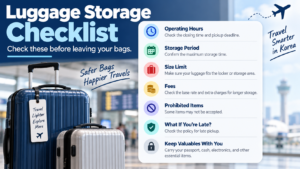
Pay particular attention to:
- Closing or retrieval time
- Maximum storage period
- Locker dimensions
- Extra charges for longer storage
- Prohibited items
- What happens if you return late
Avoid leaving passports, large amounts of cash, expensive electronics, or other essential valuables in unattended luggage whenever possible.
Use Naver Map to Plan Your Storage Location
Location matters when choosing luggage storage.
For example, storing your suitcase at Seoul Station may make sense if you will later take the AREX train or KTX. But if you plan to spend your entire afternoon in Myeongdong, finding storage near Myeongdong may save unnecessary travel.
Before choosing a location, check your hotel, subway station, airport route, and final destination on a map.
If you are unfamiliar with Korean navigation apps, see our guide to using Naver Map in Korea.
Can You Send Your Luggage Instead of Storing It?
Yes. Some luggage services in Korea provide delivery in addition to storage.
For example, Seoul Metro’s T-Luggage service includes same-day luggage delivery options on supported routes. This can be useful when changing hotels or traveling between major transportation points.
Delivery conditions and supported locations can change, so confirm the current route and pickup requirements before booking.
Tips for Traveling With Luggage in Korea
A little planning can make travel days much easier.
- Check hotel luggage storage before paying for another service.
- Look for storage close to your final transportation point.
- Allow extra time to retrieve your suitcase.
- Check locker size before bringing a large suitcase.
- Keep your passport, wallet, phone, medication, and other essentials with you.
- Take a photo or screenshot of your storage location and retrieval information.
This last tip is especially useful in large subway stations. Some stations have many exits and underground corridors, making it surprisingly easy to forget exactly where you left your luggage.
Final Thoughts
Finding where to store luggage in Korea is usually straightforward once you know your options.
For short stops in Seoul, subway lockers can be convenient. Travelers with larger suitcases may prefer staffed services such as T-Luggage, while hotel storage can be the simplest solution before check-in or after check-out when the property offers it.
The key is to plan around your itinerary. Check storage availability, operating hours, luggage size limits, and your next destination before leaving your bags.
With your suitcase safely stored, you can spend your final few hours exploring Korea instead of dragging your luggage through subway stations and crowded streets.