
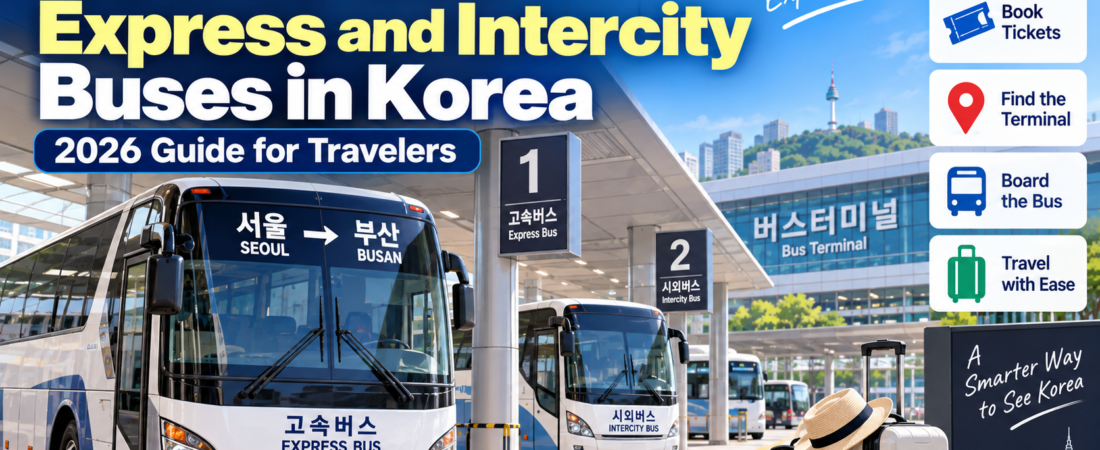
Express and intercity buses are one of the easiest ways to travel between cities in Korea, especially when your destination is not directly connected by KTX or another train service.
For foreign travelers, the most confusing parts are usually choosing the correct bus type, finding the right terminal, booking with an international card, and knowing whether a printed ticket is required.
This guide explains how to use express and intercity buses in Korea, how to book tickets, where to board, what to expect during the trip, and how these buses differ from ordinary city buses.
What Is the Difference Between Express and Intercity Buses?
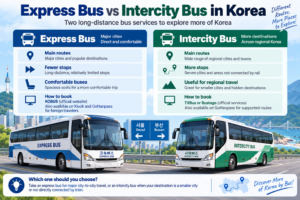
Korea uses both express buses and intercity buses for long-distance travel.
They may look similar to travelers, but they operate through different networks and reservation systems.
Express Bus
Express buses generally connect major cities and large bus terminals using longer-distance routes with relatively limited stops.
Intercity Bus
Intercity buses connect a wider range of regional cities and towns and may serve destinations that are not connected by rail.
Intercity buses can be especially useful when traveling to smaller cities or regional destinations.
When Should You Take a Bus Instead of KTX?
KTX is fast and convenient between major rail-connected cities, but buses can be better when:
- Your destination does not have a train station
- The bus offers a more direct route
- The bus terminal is closer to your final destination
- You are traveling to a smaller regional city
- The train route would require one or more transfers
VISITKOREA specifically notes that intercity buses reach many destinations not served by Korea’s railway network.
For train travel, see our
How to Book KTX Tickets in Korea guide
.
How to Find the Correct Bus Terminal
One of the most important steps is confirming the correct departure terminal.
Large cities may have more than one bus terminal, and different routes can depart from different terminals.
Before leaving your hotel, confirm:
- The exact terminal name
- The terminal address
- Your departure city
- Your destination city
- Your departure time
- Your bus type
Do not assume that every long-distance bus leaves from the same terminal.
Use your booking confirmation and a navigation app to verify the terminal before departure.
Our
How to Use Naver Map in Korea guide
can help you locate the correct terminal.
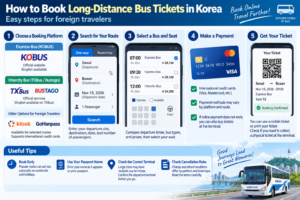
How to Book Express Bus Tickets
Express bus tickets can be booked online through the official KOBUS reservation system.
The official service supports Korean, English, Japanese, and Chinese.
Foreign travelers can also use international booking platforms such as Klook and GoHanpass for eligible routes.
According to current 2026 Korea Tourism Organization guidance, these platforms support foreign-issued credit cards and multilingual booking.
How to Book Intercity Bus Tickets
Intercity bus tickets can be searched and reserved through services such as:
- TXBus
- Bustago
- GoHanpass for supported routes
TXBus currently provides an English interface with ticket reservation, route information, and reservation management functions.
Because routes can differ between platforms, check more than one service if you cannot find your destination immediately.
Can Foreign Travelers Pay With International Credit Cards?
Yes, but the available payment method depends on where you book.
Korea Tourism Organization’s 2026 transportation guide states that foreign-issued credit cards are accepted at many express and intercity bus ticket machines and counters.
It also confirms that foreign-issued cards are supported for online express bus booking through Klook and Hanpass, and intercity bus booking through Hanpass. 5
However, payment compatibility can vary by route, terminal, platform, and card issuer.
If one payment method fails, try another booking channel or purchase the ticket at the terminal.
Can You Buy Bus Tickets at the Terminal?
Yes.
Tickets can also be purchased at ticket counters or ticket machines inside bus terminals.
VISITKOREA notes that payment may be accepted by cash, credit card, or mobile payment depending on the terminal and service. 6
Buying in person can be useful when:
- You are traveling on short notice
- Your international card does not work online
- You are unsure which route to book
- You need help identifying the correct destination terminal
Do You Need to Print Your Ticket?
Sometimes.
Some online reservations can be used directly, while others may require you to collect or print a physical ticket at the terminal.
VISITKOREA specifically advises travelers to confirm whether terminal ticket issuance is required after booking online. 7
Check your reservation details carefully before departure.
Do not assume that a mobile booking screen will always be enough to board.
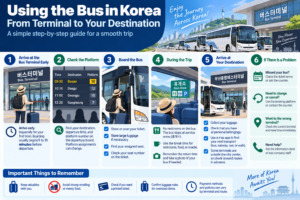
How Early Should You Arrive at the Terminal?
Arriving early is recommended, especially if it is your first time using the terminal.
Official guidance states that boarding commonly begins around 5 to 10 minutes before departure. 8
However, travelers should arrive earlier than this to:
- Find the correct platform
- Collect a printed ticket if required
- Use the restroom
- Store large luggage
- Confirm the bus destination
A practical goal is to reach the terminal with enough extra time that you are not rushing to find your platform.
How Do You Find the Correct Platform?
After arriving at the terminal, check the electronic departure board or display screens.
Look for:
- Your destination
- Departure time
- Platform or gate number
- Bus company if shown
Then go to the assigned platform.
Platform assignments can change, so check the terminal display rather than relying only on an old screenshot.
How Do You Board the Bus?
The basic boarding process is:
- Confirm the destination and departure time.
- Go to the correct platform.
- Wait until boarding begins.
- Show or scan your ticket as instructed.
- Store large luggage if necessary.
- Find your assigned seat.
Many long-distance bus tickets include an assigned seat number.
Check your ticket before sitting down.
Can You Use T-money Instead of Buying a Ticket?
Do not treat long-distance buses the same way as ordinary city buses.
For express and intercity travel, booking or purchasing a ticket is generally the normal process.
Although transportation cards may be accepted for some transportation services, travelers should follow the specific ticketing rules shown for their route and terminal.
For local city buses, see our
How to Use Buses in Korea guide
.
How Is Luggage Handled?
Long-distance buses normally have luggage storage space underneath the passenger cabin.
Larger suitcases are usually placed in the baggage compartment before boarding.
Keep valuable items, passports, money, electronics, medication, and important documents with you rather than placing them in stored luggage.
When you arrive, remember which luggage compartment your bag was placed in.
Is There a Luggage Fee?
Standard personal luggage is commonly carried as part of the trip, but policies can vary depending on bus company, luggage size, and unusual items.
If you are carrying oversized luggage, sports equipment, or several large bags, check with the operator before traveling.
Are There Restrooms on the Bus?
Generally, no.
VISITKOREA states that Korean long-distance buses do not usually have onboard restrooms. 9
Instead, longer routes may stop at highway service areas known as 휴게소 (hyugeso).
These rest areas commonly provide:
- Public restrooms
- Restaurants
- Convenience stores
- Snack shops
- Other traveler facilities
How Long Are Rest Stop Breaks?
The exact break time depends on the route and driver schedule.
When the bus stops at a service area, pay close attention to the return time.
Do not assume the driver will wait if you return late.
It can help to take a photo of the bus number or license plate so you can identify your bus among several similar vehicles.
Can You Eat on the Bus?
Policies and etiquette can vary.
Small snacks and drinks may be acceptable on some buses, but strong-smelling or messy food should be avoided.
Follow any posted rules and keep your seat area clean.
What Happens When You Arrive?
Long-distance buses normally arrive at a bus terminal or designated regional stop.
After getting off:
- Collect your luggage.
- Check that you have all personal belongings.
- Open your navigation app.
- Plan your local bus, subway, taxi, or walking route.
Some regional terminals may be located outside the main tourist center, so check onward transportation in advance.
What If You Go to the Wrong Terminal?
First, confirm whether your bus departs from a different terminal in the same city.
Use your map app to calculate the travel time to the correct terminal.
If you may miss your departure, check the cancellation or modification rules for your ticket immediately.
Do not automatically take a taxi without checking the distance and remaining time.
What If You Miss Your Bus?
Missed-bus rules depend on the ticket type and booking platform.
Check your reservation terms or speak with the ticket counter as soon as possible.
You may need to purchase a new ticket for a later departure.
Refund or change eligibility can depend on how close you are to the departure time.
Can You Change or Cancel a Ticket?
Most reservation systems provide cancellation or modification options, but conditions and fees depend on the service and timing.
TXBus, for example, provides reservation management and cancellation guidance through its online system. 10
Always check the exact conditions attached to your ticket rather than assuming all platforms use the same policy.
Express Bus vs Intercity Bus vs KTX
| Option | Best For | Main Advantage |
|---|---|---|
| Express Bus | Major city-to-city travel | Direct long-distance routes |
| Intercity Bus | Regional cities and towns | Reaches more destinations |
| KTX | Major rail-connected cities | Fast travel times |
The best option depends on your destination, schedule, price, and where the terminal or station is located.
Useful Korean Words at Bus Terminals
| Korean | Meaning |
|---|---|
| 고속버스 | Express bus |
| 시외버스 | Intercity bus |
| 버스터미널 | Bus terminal |
| 승차권 | Ticket |
| 출발 | Departure |
| 도착 | Arrival |
| 승강장 | Platform |
Express and Intercity Bus Quick Checklist
Before departure:
- Confirm whether you need an express or intercity bus
- Check the exact terminal
- Book your ticket
- Confirm whether a printed ticket is required
- Check your departure time and seat
- Allow enough time to find the platform
At the terminal:
- Check the departure board
- Confirm the platform number
- Keep your ticket ready
- Store large luggage
- Board the correct bus
During the journey:
- Keep valuables with you
- Remember the service-area return time
- Check your arrival terminal before getting off
Final Thoughts
Using express and intercity buses in Korea can make regional travel much easier, especially when trains do not go directly to your destination.
The most important steps are to confirm the correct terminal, book the right route, check whether you need a printed ticket, and arrive with enough time to find your platform.
Foreign travelers now have more booking options than before, including multilingual platforms that accept international credit cards. 11
Once you understand the process, Korea’s long-distance bus network can be one of the most useful ways to explore destinations beyond Seoul.