
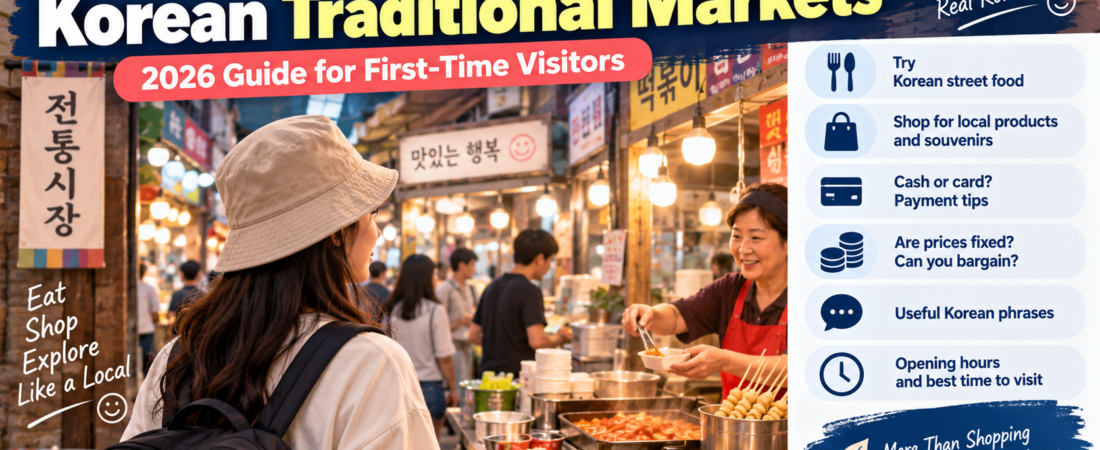
Visiting Korean traditional markets is one of the easiest ways to experience local food, everyday shopping, and neighborhood culture during a trip to Korea.
But a first visit can also raise practical questions.
Can you pay by credit card? Do you need cash? Are prices fixed? Can you bargain? How do you order food when there is no English menu?
This guide explains how Korean traditional markets work, what travelers can buy, how to pay, and what to expect before visiting.
What Is a Korean Traditional Market?
A traditional market is a shopping area made up of many independent vendors and small stores.
Unlike a department store or supermarket, each stall may have its own products, prices, payment methods, and operating hours.
Korean traditional markets are known for:
- Street food
- Fresh produce
- Seafood and meat
- Clothing
- Kitchenware
- Traditional snacks
- Souvenirs
- Local specialty products
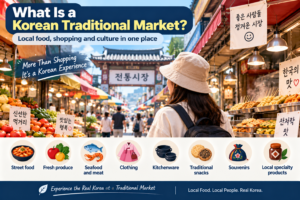
VISITKOREA describes traditional markets as places where travelers can experience both Korean shopping culture and local food.
Are Korean Traditional Markets Good for Tourists?
Yes.
Many major markets are popular tourist destinations as well as everyday shopping areas for local residents.
In 2026, the Korea Tourism Organization and the Ministry of Culture, Sports and Tourism launched a service improvement campaign at selected traditional markets.
The campaign focuses on:
- Clearer pricing
- Card payment availability
- Cleanliness and hygiene
- Friendly customer service
Participating markets include locations in Seoul, Busan, Daegu, Incheon, Jeju, and other regions.
Do Korean Traditional Markets Accept Credit Cards?
Many shops do, but not every vendor accepts cards.
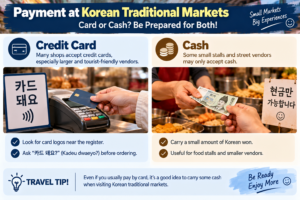
VISITKOREA advises travelers that some traditional market shops and street vendors may still accept only cash.
For this reason, carrying a small amount of Korean won is useful even if you normally pay by card.
Look for card logos near the register or ask before ordering.
How Do You Ask If a Store Accepts Cards?
You can ask:
카드 돼요?
Kadeu dwaeyo?
Does card payment work?
If the vendor accepts cards, they will normally tell you where to insert or tap your card.
For more information about payments in Korea, see our
How to Pay in Korea guide
.
Should You Carry Cash?
Yes, carrying some cash is useful.
Large and tourist-oriented vendors may accept credit cards, but small food stalls and street vendors can be more cash-dependent.
You do not need to carry a large amount.
A small amount of Korean won is usually enough as a backup when a card is not accepted.
Are Prices Fixed?
It depends on the market and vendor.
Many food stalls and retail shops display fixed prices.
The 2026 tourism campaign for selected markets specifically promotes clearer and more consistent price displays.
However, traditional markets are made up of independent businesses, so pricing practices can vary.
Can You Bargain at Korean Traditional Markets?
Sometimes, but not everywhere.
Bargaining may occur at some clothing, souvenir, fabric, or general-goods shops.
It is less appropriate when buying inexpensive street food or when a clearly fixed price is displayed.
If you want to ask politely, you can say:
조금 할인돼요?
Jogeum harin dwaeyo?
Can you give me a small discount?
If the vendor says no, simply accept the listed price.
What Can You Buy at Korean Traditional Markets?
Products vary considerably by market.
Common items include:
- Korean street food
- Dried seafood
- Seaweed
- Fruit and vegetables
- Rice cakes
- Traditional sweets
- Clothing
- Kitchenware
- Hanbok
- Local souvenirs
Some markets specialize in particular products.
For example, Daegu’s Seomun Market is especially well known for fabrics and hanbok-related products, while also having a large food scene.
Can You Eat at a Traditional Market?
Absolutely.
Food is one of the main reasons many travelers visit Korean markets.
Depending on the market, you may find:
- Tteokbokki
- Hotteok
- Fish cakes
- Mandu
- Kimbap
- Noodles
- Jeon
- Seafood
- Regional specialties
Some stalls have seats, while others are designed for standing or takeaway orders.
What If There Is No English Menu?
This is common at smaller stalls.
You can point to a displayed item, menu photo, or food being prepared.
A translation app can also help.
Useful Korean phrases include:
이거 하나 주세요.
Igeo hana juseyo.
One of these, please.
얼마예요?
Eolmayeyo?
How much is it?
Do You Pay Before or After Eating?
Payment timing varies.
Some street-food stalls ask you to pay when ordering.
Others may ask you to pay after eating.
If you are unsure, simply show your card or cash when ordering and follow the vendor’s instructions.
Do Traditional Markets Have Seating?
Some do and some do not.
Larger food alleys may have counters or communal seating.
Smaller street stalls may only offer standing space.
Do not assume that buying food guarantees a table.
Can You Take Food Away?
Yes, many market foods can be packaged for takeaway.
You can ask:
포장해 주세요.
Pojanghae juseyo.
Please pack it to go.
However, some dishes are designed to be eaten immediately and may not travel well.
Can You Try Samples?
Some vendors offer food samples, but this is not guaranteed.
If a sample is clearly offered, it is fine to try it.
Do not take food from a display unless the vendor indicates that it is a sample.
Are Traditional Markets Open Every Day?
No.
Operating days and holidays vary by market and even by individual store.
Some traditional markets close on particular Sundays or designated market holidays.
For example, current VISITKOREA information shows that some major markets have specific monthly closure days.
Always check the market’s latest operating information before making a special trip.
What Time Should You Visit?
Late morning through afternoon is usually a practical time for general shopping.
However, the best time depends on the market.
Some markets have separate night markets that become busiest in the evening.
Food stalls can also sell out before the market officially closes.
What Is a Korean Night Market?
Some traditional markets operate special evening food and entertainment areas.
These are different from the market’s regular daytime business hours.
Night markets may feature:
- Street food
- Local specialties
- Drinks
- Performances
- Small retail stalls
Schedules can be seasonal or limited to certain days of the week.
Can Foreign Tourists Visit Markets Outside Seoul?
Yes, and this can be one of the best ways to experience regional food and culture.
VISITKOREA currently promotes traditional markets across Korea, including markets in Busan, Daegu, Incheon, Jeonju, Sokcho, Andong, Jeju, and other destinations.
Regional markets often have foods and products that are closely connected to the local area.
Which Korean Traditional Markets Are Popular?
Well-known examples include:
- Namdaemun Market in Seoul
- Mangwon Market in Seoul
- Gyeongdong Market in Seoul
- Seomun Market in Daegu
- Haeundae Market in Busan
- Sinpo International Market in Incheon
- Jeonju Nambu Market
- Sokcho Tourism and Fisheries Market
- Dongmun Traditional Market in Jeju
This is not a ranking.
Each market has a different atmosphere and specialty.
Is Namdaemun Market Worth Visiting?
Namdaemun is one of Korea’s best-known traditional markets and is especially convenient for travelers staying near central Seoul.
VISITKOREA describes it as a large market selling clothing, kitchenware, gifts, food, accessories, and many other products.
Current tourism information also lists a foreigner-oriented community lounge near Gate 2 that provides market and general travel assistance.
What About Seomun Market in Daegu?
Seomun Market is one of Daegu’s most famous markets.
It is particularly known for:
- Fabrics
- Hanbok
- Clothing
- Kitchenware
- Local food
The market also has a popular night-market component on selected days.
Do You Need to Speak Korean?
No.
Basic Korean can help, but travelers can usually manage by pointing, showing quantities with their fingers, or using a translation app.
At popular tourist markets, some vendors are accustomed to serving international visitors.
Useful Korean Market Phrases
| Korean | Meaning |
|---|---|
| 얼마예요? | How much is it? |
| 이거 주세요. | This one, please. |
| 카드 돼요? | Can I pay by card? |
| 포장해 주세요. | Please pack it to go. |
| 하나 주세요. | One, please. |
| 두 개 주세요. | Two, please. |
| 조금 할인돼요? | Can you give me a small discount? |
Traditional Market Etiquette
Traditional markets are working commercial spaces as well as tourist attractions.
A few simple habits make shopping easier:
- Do not block narrow aisles while taking photos
- Ask before closely photographing vendors
- Do not touch unpackaged food unless invited
- Have payment ready when a stall is busy
- Dispose of food waste where directed
- Respect queues
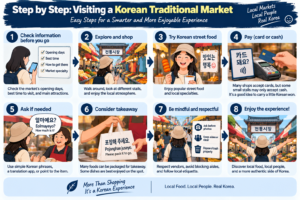
Can You Take Photos?
General market photography is common, but individual shops and vendors may have their own preferences.
If you want a close-up photo of a person, food preparation area, or private shop interior, asking first is the safer approach.
What Should You Bring?
For a comfortable market visit, consider bringing:
- A credit card
- A small amount of Korean cash
- A reusable shopping bag
- A translation app
- A map app
- Small tissues or wet wipes
If you are carrying large luggage, storing it before entering a crowded market can make the visit much easier.
See our
luggage storage guide
for options.
Korean Traditional Market vs Convenience Store
| Traditional Market | Convenience Store |
|---|---|
| Independent vendors | Standardized retail chain |
| Local foods and specialties | Packaged food and everyday items |
| Payment can vary by vendor | Card payment widely available |
| Operating hours vary | Many branches operate long hours |
| More local shopping atmosphere | More predictable shopping process |
For convenience-store basics, read our
How to Use Convenience Stores in Korea guide
.
Quick Checklist Before Visiting
- Check the market’s operating day
- Check whether there is a separate night market
- Carry a card and some cash
- Prepare a translation app
- Check the market’s specialty foods or products
- Travel light if the market is crowded
Final Thoughts
Korean traditional markets are not just places to buy food and souvenirs.
They are active neighborhood shopping areas where travelers can experience regional dishes, small local businesses, and a different side of everyday Korean life.
The biggest thing to remember is that every market and vendor can operate differently.
Card payment is increasingly common, but carrying some cash is still useful. Prices may be fixed at one shop and more flexible at another, and operating hours can vary even inside the same market.
Check the latest market information, arrive with a flexible plan, and enjoy exploring rather than expecting every traditional market to work in exactly the same way.