
Getting sick during a trip can be stressful, especially when you are in another country and do not know how the local medical system works.
Fortunately, foreign travelers can receive medical care in Korea, and many larger hospitals and clinics have experience treating international patients.
This guide explains how to see a doctor in Korea as a tourist, including how to find a clinic, what to bring, what happens during a visit, how payment and travel insurance work, how to get prescription medicine, and when to call 119 instead.
Important: This is a practical travel guide, not medical advice. If you have severe symptoms or believe you may be experiencing a medical emergency, seek emergency care immediately.
Quick Answer: How Do Tourists See a Doctor in Korea?
For a non-emergency medical problem, the usual process is straightforward:
- Find a clinic or hospital that treats your type of problem.
- Check whether English or another language is available.
- Contact the medical facility if an appointment may be required.
- Bring your passport or identification and insurance information.
- Register at the reception desk.
- See the doctor and complete any necessary tests.
- Pay the medical bill.
- Collect any medical documents you need for insurance.
- If you receive a prescription, take it to a pharmacy.
If the situation is life-threatening or rapidly worsening, do not search for an ordinary clinic first. Call 119 for emergency medical assistance.
For a complete list of useful numbers, see our Emergency Numbers in Korea guide.
Clinic or Hospital: Which One Should You Choose?
Korea has many different types of medical facilities.
For travelers, the simplest distinction is between a local clinic and a larger hospital.
Local Clinics
Local clinics are often suitable for relatively straightforward, non-emergency medical problems.
You will see clinics specializing in areas such as:
- Internal medicine
- Ear, nose, and throat
- Dermatology
- Orthopedics
- Ophthalmology
- Pediatrics
- Obstetrics and gynecology
- Dentistry
Do not choose a specialty based only on a self-diagnosis if you are uncertain about your condition. A medical professional can advise you on the appropriate care.
Larger Hospitals
Large general and university hospitals offer more departments, diagnostic equipment, specialists, and emergency services.
Many major hospitals also operate an International Healthcare Center or similar service for foreign patients.
These centers may provide services such as:
- Appointment assistance
- English or other language support
- Registration help
- Coordination between departments
- Payment assistance
- Medical documents for international patients
Exact services differ by hospital, so check before visiting.
How to Find an English-Speaking Doctor in Korea
English ability varies significantly between medical facilities.
Do not assume that every doctor, nurse, pharmacist, or receptionist will be comfortable communicating in English.
One of the most useful official resources is Medical Korea, operated by the Korea Health Industry Development Institute.
The official Medical Korea hospital directory allows travelers to search medical facilities and filter institutions by medical specialty and available interpretation language.
Medical Korea – Find Medical Institutions
Languages listed by individual institutions may include English, Chinese, Japanese, Russian, Mongolian, Vietnamese, and others.
Availability depends on the individual hospital and service, so contact the facility before your visit when language support is important.
Use Medical Korea for Help Finding Medical Care
Medical Korea also operates information services for international patients.
According to the current official information, the Medical Korea Information Center can provide information about medical institutions and assist with medical-service reservations.
The current Medical Call number is:
+82-2-1577-7129
Current official hours are listed as:
9:00 a.m. to 6:00 p.m. daily, Korea Standard Time
You can check the latest details here:
Medical Korea – Information Center
Operating hours and services can change, so check the current official page before relying on the service.
Can You Find a Clinic With Naver Map?
Yes. Naver Map can be useful for locating nearby medical facilities.
Useful Korean search terms include:
| English | Korean |
|---|---|
| Hospital | 병원 |
| Clinic | 의원 |
| Internal Medicine | 내과 |
| ENT | 이비인후과 |
| Dermatology | 피부과 |
| Orthopedics | 정형외과 |
| Ophthalmology | 안과 |
| Pediatrics | 소아청소년과 |
| Dentist | 치과 |
However, map listings should not replace confirmation from the medical facility itself.
Call or check the clinic’s official information if you need to confirm opening hours, language support, appointment requirements, or available specialties.
If you are unfamiliar with Korean navigation apps, see our Naver Map and Google Maps in Korea guide.
Do You Need an Appointment?
There is no single rule that applies to every Korean medical facility.
Some local clinics may be able to see patients without a prior appointment, while large hospitals, specialists, and international centers may use reservation systems.
Do not assume that you can walk into every hospital and immediately see the specialist you want.
If possible, contact the medical facility first and ask:
- Whether an appointment is required
- Whether English support is available
- Which department you should visit
- What identification you need
- What time registration closes
What Should You Bring to the Doctor?
Bring enough information to identify yourself and explain your health situation clearly.
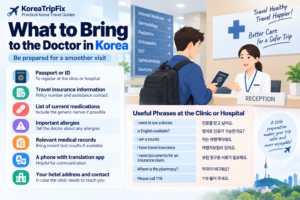
Useful items include:
- Passport or another accepted form of identification
- Travel insurance information
- Insurance assistance phone number
- A list of medications you currently take
- Information about important allergies
- Relevant medical records if available
- Your hotel address and contact information
- A phone with translation capability
If you take prescription medication, knowing the generic ingredient name can be more useful than knowing only the brand name used in your home country.
What Happens When You Arrive?
The exact process varies, but an ordinary outpatient visit may involve the following steps.
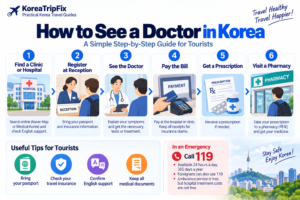
1. Registration
Go to reception and explain that you want to see a doctor.
You may be asked for identification and contact information.
2. Department or Doctor Assignment
The clinic or hospital will direct you to the appropriate department.
If you are unsure which specialty you need, explain your symptoms rather than guessing.
3. Consultation
A doctor will discuss your symptoms and medical history.
Depending on the situation, additional tests may be recommended.
4. Tests or Treatment
Tests can include laboratory work, imaging, or other examinations depending on the medical situation.
Ask about costs before non-urgent tests or procedures if price is a concern.
5. Payment
After treatment, you may need to pay at the hospital or clinic payment desk.
Keep every receipt and document if you plan to make a travel-insurance claim.
6. Prescription
If medicine is prescribed, you may receive a prescription to take to a pharmacy.
For more information about pharmacies and prescription medicine, see our How to Use Pharmacies in Korea guide.
How Much Does Seeing a Doctor Cost?
There is no reliable single price for medical treatment in Korea.
The total cost depends on factors such as:
- The medical facility
- The specialty
- The doctor’s consultation
- Tests
- Imaging
- Medication
- Procedures
- Emergency treatment
A simple clinic visit and an emergency hospital visit can have very different costs.
If your condition is not urgent, you can ask the facility about expected fees before treatment or before optional tests.
Does Korean Health Insurance Cover Tourists?
Short-term foreign visitors should not assume that Korea’s public health insurance will cover their medical expenses.
VISITKOREA advises nonresident foreign patients to contact their own insurance or medical provider about international or travel-insurance coverage and the documents needed for reimbursement.
VISITKOREA – Insurance Information for International Patients
Before your trip, check whether your insurance requires:
- Pre-authorization
- Contact with an assistance center
- Specific hospitals
- Original receipts
- Medical reports
- Proof of payment
Our Korea Travel Insurance Guide explains these issues in more detail.
Do You Pay First and Claim Later?
It depends on the medical facility and your insurance arrangement.
Some international hospitals may have direct-billing arrangements with specific overseas insurers, while many travelers may need to pay first and request reimbursement later.
Do not assume direct billing is available.
Contact your insurance provider and the hospital before treatment when possible.
What Documents Should You Ask For?
If you plan to make an insurance claim, ask what documents your insurer requires.
Useful documents may include:
- Itemized medical bill
- Payment receipt
- Medical certificate
- Diagnosis or treatment record
- Prescription
- Test results
Requirements vary by insurer.
Ask for the documents before leaving Korea if possible, because obtaining additional paperwork after returning home can be less convenient.
What If You Need Medicine After Seeing the Doctor?
If a doctor gives you a prescription, take it to a pharmacy that can fill it.
Pharmacies are called 약국 (yak-guk) in Korean.
You will often find pharmacies near clinics and hospitals.
The pharmacy may ask you to pay separately for the medication.
Keep the pharmacy receipt as well if you plan to submit an insurance claim.
What If You Only Need Simple Over-the-Counter Medicine?
Not every minor problem requires a hospital visit.
For some common, non-emergency symptoms, a pharmacist may be able to explain available over-the-counter products.
However, pharmacists cannot replace emergency or necessary medical evaluation.
If symptoms are severe, unusual, rapidly worsening, or concerning, seek medical care instead of trying to treat the problem only with over-the-counter medicine.
What If You Have a Medical Emergency?
For a medical emergency in Korea, call 119.
According to official Korean government information, 119 emergency medical services operate 24 hours a day, 365 days a year and are available to foreign nationals visiting Korea.
The government also states that the 119 ambulance service itself is provided free of charge.
This does not mean that hospital examinations, treatment, medication, admission, or other medical costs will also be free.
Korea.net – Emergency Medical Services
Do not delay emergency care because you are trying to find an English-speaking private clinic or contact your insurer first.
Hospital Emergency Room or Regular Clinic?
Use an emergency department when the situation is genuinely urgent or potentially serious.
For a stable, non-emergency problem, a normal clinic may be more appropriate.
If you are uncertain and symptoms appear severe, call 119 or seek professional medical advice rather than relying on a travel guide to decide the seriousness of the condition.
Can 1330 Help?
The 1330 Korea Travel Hotline is a tourist-information service, not a replacement for 119.
VISITKOREA currently lists multilingual assistance through 1330 for travelers.
It can be useful for general travel assistance or language-related questions, but during a medical emergency, call 119 first.
VISITKOREA – Emergency Information
Useful Korean Phrases at a Hospital or Clinic
| English | Korean |
|---|---|
| I need to see a doctor. | 진료를 받고 싶어요. |
| Is English available? | 영어로 진료가 가능한가요? |
| I am a tourist. | 저는 여행객이에요. |
| I have travel insurance. | 여행자보험이 있어요. |
| I need documents for an insurance claim. | 보험 청구용 서류가 필요해요. |
| Where is the pharmacy? | 약국이 어디예요? |
| Please call 119. | 119 불러 주세요. |
Common Mistakes Travelers Make
Going Straight to a Large Hospital for Every Minor Problem
A nearby clinic may be more practical for many stable, non-emergency medical concerns.
Assuming Every Medical Facility Speaks English
Check language availability before visiting when possible.
Not Bringing Identification
Bring your passport or other accepted identification.
Forgetting Insurance Documents
Keep your policy number and international assistance contact details accessible.
Throwing Away Receipts
Medical and pharmacy receipts may be required for reimbursement.
Assuming Treatment Is Free Because 119 Ambulances Are Free
The ambulance service and the hospital bill are separate issues.
Using 1330 Instead of 119 During an Emergency
1330 is a tourism-assistance service. Use 119 for medical emergencies.
Waiting Until You Return Home to Request Documents
If your insurer requires a medical report or itemized bill, request it before leaving Korea whenever possible.
Quick Medical Care Checklist for Korea
- Save 119 as Korea’s medical emergency number.
- Save your travel-insurance assistance number.
- Bring your passport or identification.
- Keep a list of medications and important allergies.
- Use Medical Korea to search for international-patient services.
- Confirm language availability before visiting when possible.
- Ask whether an appointment is needed.
- Keep all medical and pharmacy receipts.
- Ask your insurer which claim documents are required.
- Take prescriptions to a pharmacy if instructed.
- Call 119 immediately for a serious emergency.
Final Thoughts
It is possible for tourists to see a doctor in Korea without understanding the entire Korean healthcare system.
For a non-emergency problem, start by finding an appropriate clinic or hospital, checking language support, and confirming whether an appointment is required.
Medical Korea can help travelers find institutions accustomed to international patients, while major hospitals often operate dedicated international healthcare centers.
Keep your passport, insurance details, receipts, and medical documents organized, especially if you plan to request reimbursement after your trip.
If you receive a prescription, use a pharmacy to obtain the medication and keep the pharmacy receipt.
Most importantly, do not treat an emergency like a normal clinic visit. For a serious or rapidly worsening medical situation, call 119.
Medical facility hours, language services, insurance arrangements, and reservation procedures can change. Check the latest official Medical Korea, VISITKOREA, and individual hospital information before visiting.